Jean-Christophe Blanchard, Docteur en histoire, ingénieur d'études au Centre de Recherche Universitaire Lorrain d'Histoire, Université de Lorraine
The International Geography festival puts Saint-Dié on the map, but its map-making history dates back to the early 16th century, when the French town in the Vosges was a hotspot for scholarly geographical research.
Texte intégral (1922 mots)
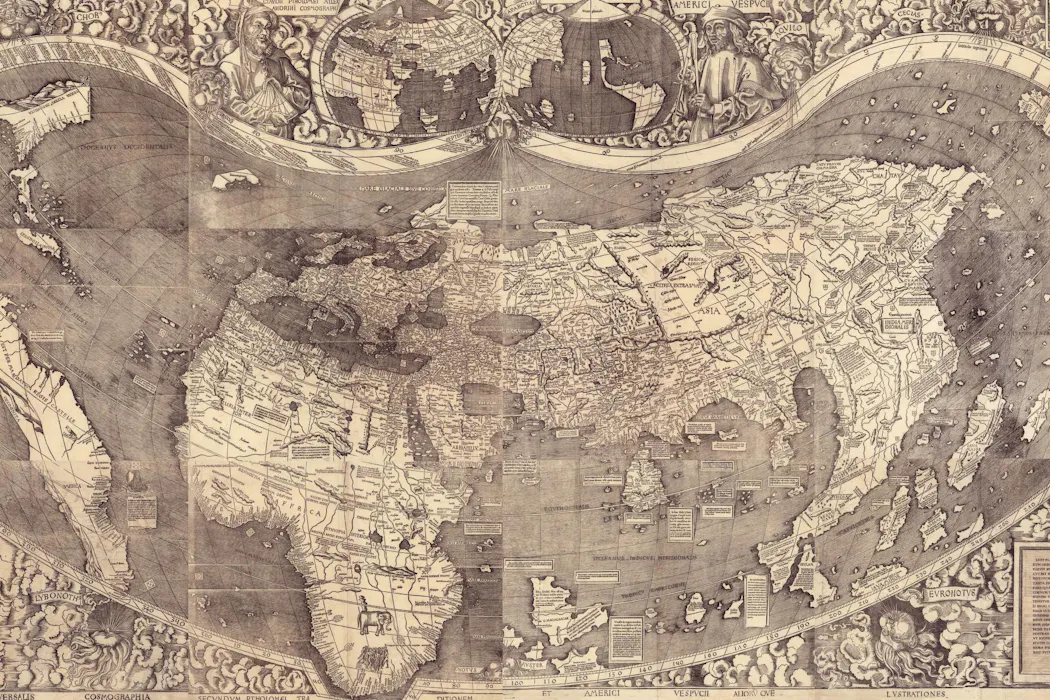
*Universal cosmography according to the Ptolemaic tradition and the surveys of Amerigo Vespucci among others*, Martin Waldseemüller, Strasbourg, 1507.Fourni par l'auteur
KEY TAKEAWAYS
The 37th International Geography Festival runs until October 4 in the north-eastern French town of Saint-Dié-des-Vosges.
The festival commemorates a historical event: it was in Saint-Dié at the start of the 16th century that the “new continent” was officially named America in a tribute to Amerigo Vespucci.
Geographical research from the Vosges region highlights the integration of France’s north-eastern Lorraine region into European scholarly networks.
“No one should consider themselves guilty of lacking geographical knowledge if they have never heard of the name of the small town of Saint-Dié.”
Does this introduction still apply to Saint-Dié-des-Vosges today? Apparently not.
Since 1990, the International Geography Festival has commemorated the town’s defining historical event, drawing prominent figures from around the world each October to the “small town” in the Vosges mountains where the New World was officially named.
Yet, when the Library of Congress presents the only known copy of German cartographer Martin Waldseemüller’s world map (acquired in 2001), it suggests Strasbourg rather than Saint-Dié as the location where it was printed, making the “small town” invisible once more.
The Vosges Gymnasium, a community of humanist scholars
The choice of the largest library in the world does not do justice to this town in the Vosges. It was here ‘within its walls’ in the early 16th century that the new continent was given the name America. It was here that René II of Lorraine, King of Naples and Jerusalem (1493-1508), who for a time planned to travel to Naples, encouraged the work of the Gymnasium vosgien, a community of humanists who were particularly interested in geography.
The Duke, who had received a French copy of Amerigo Vespucci’s letter recounting his four voyages – The Soderini Letter, dated September 4 1504 from Lisbon, Portugal understood the interest the community might have in their work. This letter, which contained the account of four trips by the Florentine explorer and navigator who was already well-known thanks to his Mondus novus pamphlet, was therefore forwarded to the Saint-Dié Cenacle, who was working on a new edition of Ptolemy’s Geography.
Immediately translated into Latin, German poet and scholar Mathias Ringmann incorporated the letter in the Cosmographiae Introductio (1507) which accompanied the new representation of the world conceived by Martin Waldseemüller and, in homage to Vespucci, it was decided that the new continent would be named America.
The geographical research in the Vosges demonstrates the integration of France’s north-eastern Lorraine region into the scientific networks of Europe. In this regard, the Portuguese provenance of the letter must first be underlined. It shows the interest of René II for what happened beyond the region and its principalities of that time.
The Duke of Lorraine was fascinated by the Portuguese and Spanish seafaring expeditions. Moreover, before coming to settle in the Galilee valley – an old community of communes located in the Vosges –, the scientists who explored the cradle of this world map had studied in various European cities. Basin had attended the University of Bologna. The Hellenist Mathias Ringmann, a former student at Heidelberg, had passed through Paris and Strasbourg and Waldseemüller who studied for a time in Freiburg-en-Brisgau had made connections in Strasbourg and Basel before settling in Saint-Dié. Ideas, books and scholars also ventured beyond the princely networks.
A wider world
Antoine de Lorraine, son of René II, who became Duke in 1508, was also attentive to the broadening of the globe. He showed interest in the progress of geographical science and navigation techniques. Its library, part of which is known thanks to an inventory, bears witness to this. The works of the Vosgien Gymnasium, and the Cosmographiae Introductio, in particular do not appear there, but there are two maps of France (a “large gallican in parchment” and another smaller one), a Livre du compas de la navigation, a printed edition of the New World and finally, another manuscript entitled La Navigation et découverte des Indes supérieures.
The first volume (on the Mediterranean) can be compared to a 15th century manuscript, preserved in Paris at the Bibliothèque nationale de France (ms.fr. 25376), entitled Le Livre du compas, c’est assavoir le livre de navighier. The second is a version of the French translation of Mundus novus, by Amerigo Vespucci, reissued several times from 1515 to 1529. The third is to be compared with one of the four manuscripts in Antonio Pigafetta’s account of Magellan’s expedition around the world to the Moluccas (1519-22) (New-Haven, Beinecke Library, ms. 351). The maps and the Livre du compas could have been inherited from René II, Mundus novus and Pigafetta’s account are, on the other hand, contemporaries of Antoine’s time.
Diplomatic gifts
The latter had the opportunity to confront the materiality of this broadening of (the known) horizons. America was given its official name during the reign of René II, but it was in his son Antoine’s time that the idea that had been an abstraction materialised. He had the privilege of receiving some indigenous artefacts sent from Mexico to Charles V by Hernàn Cortès.
The latter, seeking the support of the Habsburgs in his conquest of the Aztec Empire, had sent them to Spain in 1519. As early as 1520, this treasure was exhibited in Brussels. Albrecht Dürer was able to admire these wonderful objects during his journey through the Netherlands and recorded their memory in his diary.
In 1523, Charles offered his aunt Margaret of Austria, the governess of the Netherlands, a part of this treasure. Seventy-eight “feather accoutrements hailing from the Indies”, transferred from Brussels to Mechelen, were inventoried in the archduchess’s bookshop in 1524. On July 6, 1528, Marguerite gave Antoine de Ville, ambassador to the Duke of Lorraine, fourteen of these precious artefacts as a gift, consisting mainly of military equipment as well as textile items adorned with gold and feathers.
This diplomatic gift came against the backdrop of Charles d’Egmont’s succession pitting the dukes of Cleves and Lorraine against the emperor over the duchy of Guelders. At the end of the 1520s when hostilities with the Kingdom of France resumed, it was imperative for Charles V to find peaceful solutions to this conflict.
The diplomatic activity that then unfolded allowed him, in addition to avoiding the union of François de Lorraine and Anne de Clèves, to conclude with Charles d’Egmont the treaty of Gorinchem (October 1528). Prudently, after the death of Charles d’Egmont (1538), the Duke of Lorraine renounced his Guelder inheritance, not without concession from the emperor, who granted him veritable autonomy in his duchy under the Treaty of Nuremberg (1542).
Antoine, a descendant of the man who baptised America, did not risk competing with the ruler of New Spain, Peru, New Granada, and the Río de la Plata, among others. By accepting native artefacts and negotiation, the Duke of Lorraine was able to enjoy the largesse of someone who ruled an empire on which the sun never set. He thus continued the work of his father and ensured the sustainability of Lorraine’s principalities. At the dawn of the 21st century, across the Atlantic this is not enough; however, for us to remember the “little town” in Lorraine where America was officially given the name it carries to this day.
Find Jean-Christophe Blanchard’s essay on the subject (in French), entitled “1507 : Saint-Dié, les ducs de Lorraine et l’Amérique” in the book Histoire européenne de la Lorraine en 100 dates by Isabelle Brian and Laurent Jalabert (Strasbourg, La Nuée Bleue, 2025, p. 283-289).
A weekly e-mail in English featuring expertise from scholars and researchers. It provides an introduction to the diversity of research coming out of the continent and considers some of the key issues facing European countries. Get the newsletter!
Jean-Christophe Blanchard ne travaille pas, ne conseille pas, ne possède pas de parts, ne reçoit pas de fonds d'une organisation qui pourrait tirer profit de cet article, et n'a déclaré aucune autre affiliation que son organisme de recherche.
Sacha Kacki, Chargé de recherche CNRS en anthropologie biologique, Université de Bordeaux
Damien Charabidzé, Professeur en Biologie, Université de Lille
En révélant les mutations qu’ont connues nos modes de sépulture au fil des siècles, l’archéologie bat en brèche l’idée d’une immuabilité des pratiques funéraires et questionne notre rapport au devenir des corps après la mort.
Texte intégral (3155 mots)
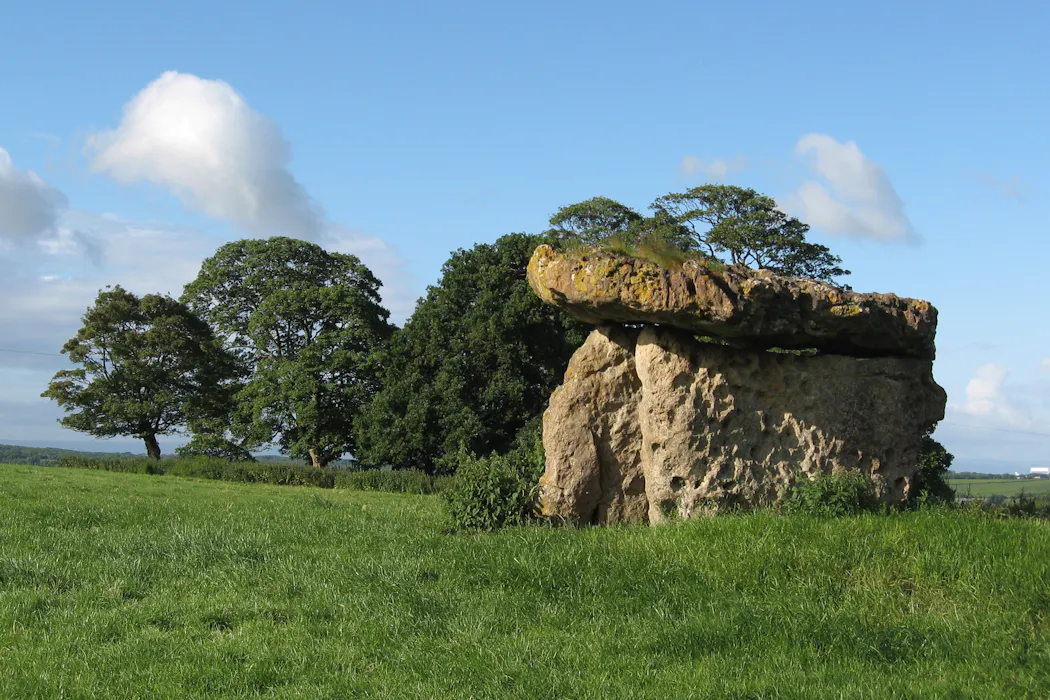
La chambre funéraire de St Lythans, au Royaume-Uni, témoigne de pratiques remontant au milieu du Néolithique, 4000 ans avant notre ère.Chris Andrews / Wikimedia Commons, CC BY
Que deviennent nos corps après notre décès ? Dans des sociétés où la mort est de plus en plus invisibilisée, comment ont évolué nos rites ? Demain, à quoi ressembleront les cimetières ? L’enterrement ou la crémation seront-ils remplacés par d’autres méthodes ? Comment le numérique transformera-t-il nos pratiques funéraires ?
Pour répondre à ces questions et à bien d’autres, nous vous proposons une série de six articles sur le thème « Le corps après la mort », rédigés par des experts et illustrés par le dessinateur Vito.
Ce deuxième épisode est consacré à la façon dont les rites funéraires se transforment. Dans les sociétés occidentales actuelles, le traitement des défunts répond à des normes strictes et s’exprime par une mise en œuvre technique hautement standardisée. Si ces pratiques nous semblent immuables, l’archéothanatologie nous apprend qu’elles ont beaucoup varié au fil des siècles. Et demain, que restera-t-il de nos nouvelles pratiques ?
L’ESSENTIEL
Aujourd’hui, en France, les corps des défunts sont enfermés dans des cercueils, qui sont soit enterrés (inhumation), soit brûlés (crémation).
Il n’en a pas toujours été ainsi : les pratiques funéraires ne sont pas immuables, elles se transforment au fil des siècles.
Pour comprendre ces évolutions, une discipline étudie les rites funéraires du passé : l’archéothanatologie.
En France, à l’instar de ce qui est pratiqué dans d’autres pays européens, le corps d’un défunt doit obligatoirement être disposé dans un cercueil, traditionnellement fait de planches de bois. Enfermé dans ce contenant, il peut alors être soit enterré (inhumation), soit brûlé (crémation).
Ces rites sont aujourd’hui si profondément ancrés dans nos traditions qu’on pourrait les croire intemporels. Mais est-ce vraiment le cas ? Les funérailles ont-elles toujours reposé sur les mêmes procédés ?
Pour répondre à ces interrogations, l’éclairage qu’apporte la recherche archéologique est primordial. En permettant d’objectiver certains aspects des pratiques déployées dans les sociétés anciennes, elle documente leur diversité, et remet en question l’apparente immuabilité des rites funéraires.
L’archéothanatologie, une discipline récente
Qu’elles soient mises au jour lors de fouilles archéologiques ou dans le cas plus spécifique du déménagement d’un cimetière, les sépultures présentent un intérêt majeur pour les archéologues.
Si l’attrait de ces derniers fut, un temps, plus tourné vers les objets d’accompagnement que vers les défunts en eux-mêmes, la tendance s’est progressivement inversée depuis un demi-siècle, à la faveur de l’émergence d’une nouvelle discipline : l’archéothanatologie.
Formalisée au tournant des années 1980, cette approche, qui ne prendra son nom actuel qu’au début du XXIᵉ siècle, repose sur l’étude des restes humains archéologiques et des éléments constitutifs de leur environnement.
Sa mise en œuvre passe, avant toute autre chose, par la fouille méticuleuse des sépultures, afin de dégager les ossements et les éventuels vestiges participant de l’architecture funéraire.
Après qu’ils ont été exposés, l’examen de leurs relations réciproques permet aux spécialistes, formés en anatomie humaine et en taphonomie (l’étude des processus de dégradation d’un corps enfoui), de retracer les évènements intervenus durant la dégradation organique du cadavre.
De là, ils peuvent en déduire certaines des caractéristiques originelles du dépôt funéraire, telle la présence d’un espace vide ou au contraire de terre autour du corps durant la décomposition, ou encore l’existence initiale d’une paroi ou d’un fond en matériau périssable aujourd’hui disparu (comme, par exemple, ceux d’un cercueil en bois).
L’étude ultérieure des restes osseux en laboratoire peut en outre révéler des stigmates de pratiques funéraires particulières (par exemple, des traces de découpe évoquant une excarnation – une pratique consistant à enlever la chair et les tissus mous d’un cadavre – ou un embaumement).
Des altérations taphonomiques spécifiques à un environnement de dépôt peuvent aussi être mises en évidence (par exemple, des traces d’activités de certains insectes).
En parallèle, l’analyse des sédiments collectés dans les tombes peut permettre d’y repérer divers vestiges invisibles à l’œil nu, tels que graines, pollens, micro-restes végétaux ou vestiges d’insectes, qui tous peuvent révéler des caractéristiques du dépôt funéraire. À titre d’exemple, l’identification en microscopie de phytolithes, des restes siliceux qui s’accumulent entre les cellules des plantes, pourra révéler la présence d’un matelas en matière végétale sur lequel reposait le corps.
L’ensemble de ces observations, alliées à celles portant sur les vestiges architecturaux conservés (par exemple, dalles de pierre, clous, épingles de linceul ou restes organiques), servent finalement à l’archéothanatologue pour reconstituer les caractéristiques des tombes et certains des traitements appliqués au défunt dans le cadre des funérailles.
Couplées aux éléments de datation (typologie du mobilier, datations par le radiocarbone), elles permettent de dresser un panorama des pratiques funéraires et de leur évolution au fil du temps.
Des pratiques funéraires en mutation
Les plus anciennes sépultures connues, découvertes au Proche-Orient, datent de plus de 100 000 ans. Elles sont le fait de Néandertaliens aussi bien que de représentants de notre espèce, Homo sapiens.
Depuis lors, les humains ont développé des pratiques funéraires aussi variées qu’élaborées, dans le cadre desquelles le corps a pu, selon les cas, être enterré (en pleine terre ou dans un contenant), déposé en surface (en plein air ou dans des grottes ou monuments), brûlé, immergé, ou encore volontairement morcelé avant ou après sa décomposition.
Cohabitant parfois dans une même société, crémation et inhumation se sont succédé l’une l’autre en importance durant la Protohistoire (période de l’histoire précédant l’invention de l’écriture) et l’Antiquité, avant que l’inhumation ne soit adoptée de manière hégémonique au cours du Moyen Âge et de l’époque moderne.
Ces dernières périodes, les plus proches de nous chronologiquement, ont vu l’adoption de nombreux usages dont nos pratiques funéraires actuelles tirent leurs racines. Ainsi, tandis que les sépultures étaient précédemment implantées dans des nécropoles situées en bord de voie ou en plein champ, le regroupement des morts dans des cimetières paroissiaux attenants aux églises s’est rapidement imposé au Moyen Âge. Chaque défunt y était inhumé dans une sépulture individuelle, allongé sur le dos, le plus souvent la tête à l’ouest.
Cependant, en dépit de ces caractéristiques communes, l’étude des sépultures d’alors révèle une forte diversité. Durant les premiers siècles du Moyen Âge (du VIᵉ au Xᵉ siècle), les défunts pouvaient ainsi, selon leur statut et les us régionaux, être inhumés dans de simples fosses comblées de terre ou dans des contenants de types variés : sarcophages en pierre ou en plâtre, coffrages faits de planches, de dalles de pierre ou de tuiles, chambres funéraires en bois, etc. Dans bien des cas, la signalisation des tombes n’était assurée que par de simples croix en bois.
Vers une homogénéisation des pratiques
La seconde partie du Moyen Âge (du XIᵉ au XVᵉ siècle) fut marquée par une rétraction progressive de cette diversité, au profit de l’adoption majoritaire d’inhumations dans des coffrages de bois ou de pierre.
Dans le même temps, la saturation des espaces funéraires conduisit à l’adoption de nouvelles pratiques, notamment l’emploi de caveaux destinés à accueillir des inhumations répétées, ainsi que la constitution d’ossuaires regroupant les os exhumés d’anciennes sépultures. À cette période également, il arriva régulièrement que l’on déroge à la règle de l’inhumation individuelle pour enterrer dans un même fossé plusieurs individus victimes d’une épidémie.
Ce n’est finalement qu’à l’Époque moderne (du XVIᵉ au XVIIIᵉ siècle) que l’emploi de cercueils en bois se généralisa. En parallèle, on vit se répandre, au sein des classes sociales privilégiées, de nouvelles pratiques visant à freiner la décomposition du corps : d’une part, l’embaumement par éviscération (retrait des organes), d’autre part, l’inhumation dans des cercueils de plomb.
Ces derniers usages furent cependant rapidement abandonnés, à la faveur de l’invention de nouvelles techniques de thanatopraxie et d’une normalisation de l’emploi du cercueil de bois dans le courant du XIXᵉ siècle.
Depuis lors, la plus grande évolution (pour ne pas dire révolution) qu’aient connue nos pratiques funéraires est la légalisation de la crémation en 1887. D’abord adoptée par une très faible part de la population, elle est aujourd’hui en passe de devenir majoritaire en France. L’évolution rapide qu’a connue le recours à cette pratique depuis le début du XXIᵉ siècle reflète un changement profond des aspirations d’une partie des citoyens quant au devenir de leurs corps après leur mort, pour partie dictées par des considérations écologiques.
Quelles sont les pratiques en France de nos jours ?À l’heure actuelle, la loi française impose que le corps soit disposé dans un cercueil, lequel doit être équipé d’un dispositif d’étanchéité de son fond. Les deux seules pratiques funéraires autorisées sont l’inhumation et la crémation.
Dans le premier cas, l’enfouissement doit, à de rares exceptions près, prendre place dans un cimetière. La sépulture, en simple fosse ou en caveau, est généralement signalée par un marqueur de surface, telle une dalle de marbre ou de granit.
Dans le cas de la crémation, le cercueil et le corps qu’il renferme sont consumés dans le four d’un crématorium. Les os calcinés qui subsistent à la fin du processus sont ensuite broyés (crémulation) et mêlés aux cendres issues de la crémation, puis déposés dans une urne funéraire. Ces « cendres » peuvent par la suite être déposées dans un columbarium, être dispersées dans un jardin ou puits du souvenir, ou encore être remises aux proches du défunt pour qu’ils les dispersent « en pleine nature ».
Émergence de nouvelles pratiques funéraires
On le voit, les pratiques funéraires évoluent. Elles s’adaptent aux besoins d’une époque, d’un territoire, d’une société. Il n’est donc pas étonnant de voir aujourd’hui émerger de nouvelles pratiques funéraires. Parmi celles-ci, deux visions se distinguent : la terramation et l’aquamation.
La terramation désigne un ensemble de procédés de réduction des corps reposant sur l’usage de matière végétale (broyat) afin de créer des conditions propices à l’activité des bactéries dites aérobies, c’est-à-dire utilisant l’oxygène. Contrairement aux pratiques d’enterrement classique qui freinent la décomposition, faute d’oxygène, l’objectif est ici de faciliter la décomposition du corps. Dans ces conditions de réduction organique naturelle, les chairs se transforment en produisant de l’humus, auquel peut, dans certains rites, être ajoutée la poudre issue de la pulvérisation des ossements.
L’aquamation, souvent présentée comme une « crémation par l’eau », consiste quant à elle à « déconstruire » le corps dans une solution alcaline. Ce bain va intégralement dissoudre le cadavre : ne subsistent, à la fin du processus, que de petits fragments d’os ainsi qu’un grand volume de liquide trouble, riche en courts fragments protéiques (peptides), mais sans ADN, lequel a été dégradé par le processus. Ce liquide n’étant plus identifiable au défunt, il est généralement retraité (neutralisation du pH et filtration) puis rejeté dans l’environnement viades bassins de décantation ou le réseau d’évacuation des eaux usées. Les restes osseux sont séchés, pulvérisés et rendus aux proches, comme dans le cas d’une crémation. Le procédé d’aquamation propose ainsi un récit funéraire alternatif centré sur la symbolique de la déconstruction et du cycle de l’eau.
Quelles traces pour le futur ?
Qu’il s’agisse de crémation, d’aquamation ou de terramation, les restes physiques du défunt subissent une transformation rapide (de quelques heures à quelques mois) avant d’être dispersés. Les traces tangibles de l’existence du défunt, de son corps, disparaissent. Ceci constitue une évolution majeure par rapport aux pratiques d’inhumation, qui ont conservé durant des siècles les restes de nos ancêtres et les témoins de leurs pratiques funéraires.
Alors que les traces laissées de notre vivant se multiplient, notamment du fait des données numériques, ces nouvelles pratiques funéraires interrogent ainsi notre rapport à la mort, aux espaces de mémoire et aux supports du deuil.
Remerciements
Les planches de la bande dessinée ont été réalisées par Victor Locuratolo (@Vito) ;
Le scénario a été coécrit par Victor Locuratolo et Damien Charabidzé, l’initiateur de cette série d’articles ;
Cette publication a été rendue possible grâce à un financement de l’Union du Pôle funéraire public (UPFP), structure réunissant les acteurs publics du funéraire afin de défendre et promouvoir leurs services, tout en garantissant un accompagnement digne, éthique et accessible à tous les citoyens. Elle a également bénéficié d’un financement de la Direction culture de l’Université de Lille, dans le cadre de son soutien aux projets de recherche et de diffusion associant arts et sciences.
Sacha Kacki a reçu des financements de l'Agence Nationale de la Recherche, du CNRS et de l'Université de Bordeaux. Aucun de ces acteurs n'a participé à la rédaction ou à la relecture de cet article et ne tire profit de cet article.
Damien Charabidzé a reçu des financements de l'Agence Nationale de la Recherche, du CNRS, de l'Union du Pôle Funéraire Public et de l'Université de Lille. Aucun de ces acteurs n'a participé à la rédaction ou à la relecture de ces articles et ne tire profit de cet article.
For American and European tech firms, like Microsoft or NVIDIA, the precedent is uncomfortable. Their stock market valuations rest on an assumption of scarcity: capable models being rare, costly and controlled by whoever trained them gives them an edge; a competitive advantage they can capitalise on financially.
Europe, which invented much of the solar industry and then watched its manufacturers disappear, knows what happens when that assumption fails. If a credible AI model can be downloaded for free, the premium on owning one evaporates.
The economics of deliberate loss: a case of déjà vu?
China’s strategy is not unfamiliar; we have watched it unfold twice. In both cases the science was Western, but the pricing was conquered by a method no private investor would choose: state-owned banks financed the factories regional party committees wanted, and those factories competed by selling below cost. In finance this is a negative net present value strategy, pouring in more money than you can expect to earn back.
Why would anyone do this? Because the decision-makers are not necessarily trying to make a profit. Andrei Shleifer and Robert Vishny showed that when politicians rather than shareholders steer a company, it serves political ends (employment, prestige, strategic dominance) rather than financial ones.
A private laboratory must earn a return or perish; a state champion need only serve its brief. When the two meet, the player who’s indifferent to losses sets the price. The result is abundance: plentiful supply in the form of alternative comparable models, low prices in the form of more flexible usage policies, and no lasting edge for the innovator, whose profit margins are suppressed. Considering that the two largest AI companies (Anthropic and OpenAI) are preparing for an IPO based on (currently negative) operating profits increasing significantly in the foreseeable future, this is a significant challenge.
Cheapness is also a factor in whether technology is adopted. American laboratories may keep their lead on the elite benchmarks (the standardised tests, such as the GLUE or the MMLU by which AI models are ranked) but those scores do not decide which system ends up embedded in the world’s software. Cost does. A model that is merely good enough and very cheap becomes the default others build upon, and defaults are hard to dislodge once products have formed around them.
But is the same story unfolding for AI?
The analogy deserves scrutiny. Innovation in solar panels and electric vehicles evolves in a discreet manner. New products equipped with better cell chemistry or a denser battery, compete based on other qualities, such as cost effectiveness.
In particular, the evolution of these technological inventions follows electronic engineer Gordon Moore’s 1965 observation (or Moore’s law) that the number of transistors on a chip roughly doubles every two years, so computing power climbs as unit costs fall.
Other technologies, like solar panels or EVs, follow similar curves, albeit at different rates, and see increasing innovation leading to throat-cutting competition and vanishing margins. Anything riding that kind of curve becomes a commodity: so plentiful and interchangeable that nobody can charge much for it.
Does AI ride the same curve?
The models behind artificial intelligence are loosely inspired by the brain: layers of “nodes” whose connections are adjusted until the network produces useful output. But one difference is decisive. An AI model learns once, during training, and thereafter applies what it has learned. Your brain rewires itself with every conversation; today’s AI does not. It might come close with algorithmic trading or with retrieval-augmented-generation, where a trained model adjusts its behaviour according to incoming data, but still, to make it cleverer, you must train it again with more data, more chips, more electricity. Ultimately, more resources.
A trained AI model is therefore a closed system: its abilities are determined the moment training ends. It may surprise us in how it recombines what it knows, but it is unable to pass its current level of performance without being rebuilt or retrained with more data. In a world where AI exhibits notable strategic advantages, like in defence, security, power distribution, etc., the race is on, and the demand for resources follows.
But is a techonology that tries to resemble the cognitive functions of a brain (AI), subject to Moore’s law, like a technology that exhibits no cognitive capabilities (batteries, for example)? Kurt Gödel’s incompleteness theorem offers a useful analogy here. Any closed system is a set of rules and, as such, it cannot prove itself from within. An AI model, in the current state of technology, is restricted in the same way, as it cannot widen its cognitive capabilities using its existing resources. To do so, it needs new resources (training, energy, computation) and, therefore, it is subject to a decay curve, similar to Moore’s law or the ones in solar panels and EVs, destined to meet the same fate.
But can AI deviate from that curve? Should AI models ever become evolutionary in nature (by learning as they process new information in a similar manner to the human brain), then the story changes: such a system compounds its advantage instead of competing for resources. This continuous evolution is the frontier that matters because the competitive advantage of the AI models would be based on which one learns better or faster and not on which one is cheaper.
Why it matters
Financially speaking, if the evolution of AI models remains discrete, its competitive edge will inevitably erode. A (state) champion willing to sell at a loss can push the price of “good-enough” intelligence toward its production cost and margins will fall as they did for solar cells. The implication is uncomfortable and liberating at once: durable returns will come not from owning another interchangeable model but from what is built on top – products, workflows and distribution that rivals cannot copy. As intelligence becomes cheaper, value migrates to whatever stays scarce. China leads the way here; automated drone deliveries (Meituan), driverless taxis (Baidu) or delivery robots (Alibaba) show that value emanates from efficient AI usage and not necessarily from how “smart” a model is.
This logic reframes the race. The industry’s instinct is to build ever-larger AI models burning ever more energy for marginal gains on a benchmark; yet sheer capacity is what abundance renders cheap. The more interesting prize lies with models that learn as they work, because no rival can download a moving target.
So, can AI become a commodity?
On today’s architecture, very probably – and the GLM moment is the warning shot.
The only way to stay ahead of abundance is to change the machine itself: to build intelligence that grows rather than a smarter, static model. Until then, the smart money might follow the example of solar panels: instead of financing the construction of better panels, money goes to how their use can benefit the real economy (energy independence, emissions reduction). Equivalently, instead of pushing for smarter models that might become abundant, profits will arise from smart applications using them, such as traffic control, medical screening, energy grid management, or anything that can create social benefits.
A weekly e-mail in English featuring expertise from scholars and researchers. It provides an introduction to the diversity of research coming out of the continent and considers some of the key issues facing European countries. Get the newsletter!
Iordanis Kalaitzoglou ne travaille pas, ne conseille pas, ne possède pas de parts, ne reçoit pas de fonds d'une organisation qui pourrait tirer profit de cet article, et n'a déclaré aucune autre affiliation que son organisme de recherche.