
COP31: live updates as governments meet to accelerate climate action
Aaron Gray-Block
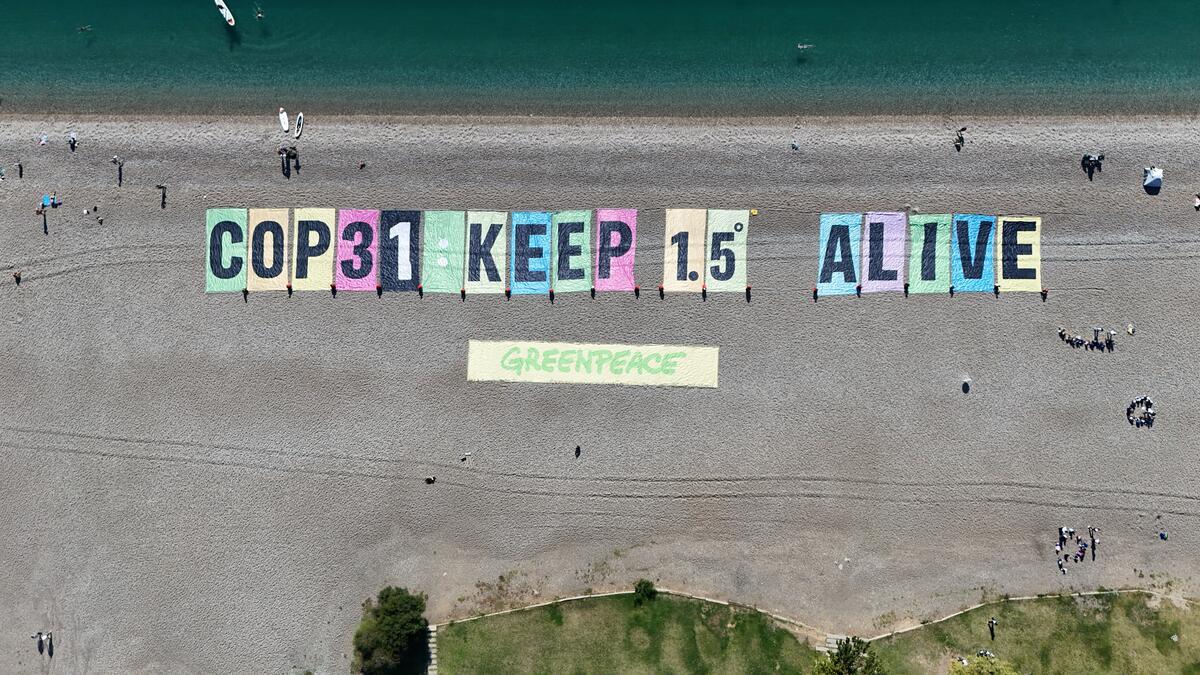
The world’s governments are gathering in Antalya, Türkiye for the annual UN climate change conference COP31, coming at a time of profound geopolitical challenges and climate instability, but also opportunities for change in a just transition away from fossil fuels. Find live updates below: November 6 On the eve of COP31, Greenpeace Türkiye activists unveiled a massive banner on the Konyaalti Beach in Antalya, calling on countries to use this year’s climate summit as a moment to make real progress in global efforts to address the escalating climate crisis. This year’s annual climate summit will be the first since the United Nations Environment Programme (UNEP) declared in a landmark report in September that the world will overshoot the 1.5°C global warming limit set out in the Paris Agreement, likely within the next few years. It was a heartbreaking moment, the type of news that must finally spark governments into action. Greenpeace is calling on countries meeting in Antalya to respond with the urgency that has been absent for too long. That means ensuring progress towards a fair, fast and funded transition away from fossil fuels and ending forest destruction by 2030, as agreed at COP28. The Greenpeace Türkiye banner said COP31: KEEP 1.5°C ALIVE and was large enough to be photographed by a passing satellite as a symbol of our planetary plight. It was the first time Greenpeace had used a satellite to take an image of a banner. The giant banner was photographed by a passing Planet Labs PBC Pelican satellite at 1205 (TRT). The satellite imagery was obtained and processed by Earth observation experts from the Greenpeace International Global Mapping Hub. Texte intégral (557 mots)
Greenpeace live blog coverage of COP31
COP31 will be held from 9-20 November 2026 and Greenpeace will be covering the conference with a live blog, bringing you regular updates and insights. Check back here for rolling updates throughout the coming two weeks.Greenpeace Türkiye displays giant banner calling for 1.5°C action
Looming 1.5°C overshoot must spark action to end fossil fuels at COP31 – Greenpeace
Greenpeace International
Antalya, Türkiye – Greenpeace has called on governments at the UN climate summit COP31 to respond to the looming overshoot of 1.5°C with urgent action to phase-out fossil fuels and end forest destruction to limit the extent and duration of the overshoot. After the stark reality check from the UN Environment Programme (UNEP) confirming an overshoot of the 1.5°C global warming limit will occur, the test at COP31 is whether governments can respond with action. Antalya must break the cycle of negotiations that produce incremental compromises rather than the breakthroughs needed to confront the worsening climate crisis. Jasper Inventor, Head of COP31 Greenpeace Delegation said: “The world is not short of climate promises, but we’ve run out of time to prevent a 1.5°C overshoot. Now COP31 must prove how climate diplomacy can deliver real change, not just more commitments that governments spend the next decade discussing how to implement. “COP31 needs to secure a breakthrough that delivers. Every fraction of a degree matters and every year of delay makes the consequences more severe. We need a fast, fair and funded transition away from fossil fuels, an end to forest destruction, urgently required climate finance for developing countries, and to make those most responsible for the climate crisis pay their fair share. “An agreement at COP31 that falls short of what science demands is not a breakthrough, no matter how many countries sign up to it. Implementation cannot mean doing the bare minimum. It’s time for action.” Ahead of the start of COP31, Greenpeace Türkiye activists displayed a giant banner on the Konyaaltı Beach in Antalya that was visible from space as a symbol of the planetary plight. The banner, which read COP31: KEEP 1.5°C ALIVE, was photographed by satellite. Photos are available from the Greenpeace media library and an overview of Greenpeace’s expectations and activities at COP31 are found below.[1][2] Berkan Özyer, Director of Greenpeace Türkiye, said: “As we face one of the most severe energy crises of the last century and the looming 1.5°C overshoot, the need for urgent action has never been clearer. A powerful call is rising from local communities and civil society across Türkiye for a just transition away from fossil fuels and we are bringing this voice directly to COP31. “Türkiye should view its COP31 presidency as a genuine opportunity to demonstrate real climate leadership. The electrification goal will only succeed if it is anchored in a phase-out of fossil fuels and powered by renewable energy. As COP31 host, Türkiye cannot champion global pledges while ignoring contradictions at home: plans for new coal-fired power plants must be immediately canceled, a clear timeline for a just transition away from coal must be announced, and plastic waste imports must be completely banned as the true test of its ‘Zero Waste’ vision.” Shiva Gounden, Head of Pacific at Greenpeace Australia Pacific said: “International law and climate science tell us that 1.5°C is a lifeline for our communities, but the political landscape treats overshoot like a temporary inconvenience. In the Pacific, we know the truth: once our reefs die and our lands disappear under rising seas, there is no coming back, no matter how much carbon you try to pull out of the air decades down the line. This is irreversible harm! “The COP31 electrification push will mean nothing if it’s used to disguise the real problem – fossil fuels. If this COP is to deliver real implementation, it must address the extraction driving us into overshoot. For this to truly be the implementation COP, what actually matters is a binding, managed, funded and urgent phase-out of fossil fuels.” ENDS Photos and video are available in the Greenpeace media library Notes: [1] Greenpeace: COP31 Priorities and Expectations [2] Greenpeace: COP31 Media Briefing and Activities Beyza Kural, Senior Communication Expert, Greenpeace Türkiye, +90 5336 417 123, beyza.kural@greenpeace.org Kate O’Callaghan, Communications Manager, Greenpeace Australia Pacific, +61 4062 31892 kate.ocallaghan@greenpeace.org Greenpeace International Press Desk, +31 (0)20 718 2470 (available 24 hours), pressdesk.int@greenpeace.org Texte intégral (804 mots)
Contacts:
Action needed as UNEP adaptation report exposes climate finance injustice
Greenpeace International
Amsterdam, Netherlands – Greenpeace has called on countries to step up adaptation finance at the UN climate talks COP31 as the United Nations Environment Programme exposed the widening gap in critical finance for developing countries. The UNEP’s Adaptation Gap Report 2026 showed international public adaptation finance flattened at USD28.2 – 31.7 billion in 2024, representing just a USD1 billion year-on-year increase. In contrast, developing countries face annual adaptation needs of USD305 billion, which is expected to rise to USD420 billion by 2035 with inflation. It means that even tripling flows by 2035 will only cover 20 to 29% of what vulnerable nations require.[1] Koaile Monaheng, Climate Finance Expert, Greenpeace International said: “The math of climate injustice is here in plain sight, with adaptation needs woefully underfunded. This leaves frontline communities, who have contributed the least to global emissions, facing escalating climate extremes with a fraction of the support. This is morally indefensible. Adaptation is not a luxury, but critical for human survival, dignity and justice. “Every delay in adaptation funding turns climate impacts into catastrophic losses and damages. At COP31, governments must confront this reality and the widening adaptation finance deficit by immediately scaling up grant-based funding to meet the goal to at least triple adaptation finance by 2035.” At COP31, Greenpeace is calling for developed country governments to announce ambitious multi-year post-2025 climate finance commitments that reflect their country’s fair share in delivering the USD300 billion New Collective Quantified Goal agreed at COP29 in Baku.[2][3] Under the Global Goal on Adaptation (GGA) agreed at COP30, developed nations must clarify how they will triple adaptation finance to reach at least USD120 billion annually by 2035, alongside recognising the need for a robust, needs-based adaptation finance commitment. [4] This has to be delivered through grant-based and non-debt-creating mechanisms rather than loans that trap vulnerable countries in spiralling debt. Monaheng added: “To unlock these funds, governments must make polluters pay. Taxing the massive profits of oil and gas corporations through progressive environmental taxation is one of the clearest ways to generate new public finance. This money must be channeled directly into public adaptation and multilateral funds, including the Fund for Responding to Loss and Damage, where initial funding requests of USD2.8 billion vastly outstripped the available USD342 million envelope.” ENDS Notes: [1] UNEP’s 2026 Adaptation Gap Report: Ready? Not [2] Greenpeace: COP31 Priorities and Expectations [3] New Collective Quantified Goal Contacts: Aaron Gray-Block, Greenpeace International, Climate Politics Communications Manager, aaron.gray-block@greenpeace.org Greenpeace International Press Desk, +31 (0)20 718 2470 (available 24 hours), pressdesk.int@greenpeace.org Texte intégral (556 mots)
COP30 roadmaps are a critical step, but urgent 1.5°C action needed at COP31
Greenpeace International
Brasília, Brazil – Greenpeace has urged countries to use the Brazil COP30 Presidency’s roadmaps on ending deforestation and transitioning away from fossil fuels as a driving force for next week’s UN climate summit COP31 to help deliver a 1.5°C future. After committing to developing the roadmaps at COP30, the Brazil presidency unveiled the roadmaps in Brasília, today. The Roadmap for Transitioning Away from Fossil Fuels (TAFF) outlined different scenarios and measures to facilitate the transition, while taking into account different national circumstances and reinforcing the importance of climate justice.[1] The 2030 Forests Roadmap highlights existing efforts to combat forest loss, the international architecture for forest action and for financing it, and provides concrete proposals for the road ahead as part of international efforts to end forest destruction by 2030, as agreed at COP28. Carolina Pasquali, Executive Director, Greenpeace Brazil said: “This is a major effort by the COP30 Presidency and a crucial step towards ensuring the COP28 decision to transition away from fossil fuels is fully implemented. As our climate races towards a 1.5°C overshoot, the roadmap encourages important measures but stops short of setting clear fossil fuel phase-out targets or calling for an immediate halt to the expansion of fossil fuels. “The Forests Roadmap also represents a major effort from the COP30 presidency and was launched with the credibility of a Brazilian government that has achieved the lowest deforestation rate in its history. The presidency has helped bring together, through multiple contributions and dialogues, a wide range of existing initiatives and views.” Tracy Carty, Climate Politics Expert, Greenpeace International said: “Brazil’s TAFF roadmap makes clear that the pace of the transition is falling well short of achieving 1.5°C. While it misses the mark by failing to include explicit phase-out timelines, it recognises the need for accelerated action in line with justice and equity and backed by finance. “The fossil fuels roadmap must now serve as a catalyst to raise ambition and drive urgent action at COP31 and beyond. COP31 can and must deliver concrete action to end fossil fuels: including agreeing a global 35 percent by 2035 electrification goal to propel renewable power and displace fossil fuels, establishing a Just Transition Mechanism to co-ordinate, guide and enable support for workers and communities and securing scaled-up international climate finance for implementation.” An Lambrechts, Biodiversity Politics Expert, Greenpeace International said: “To return global warming to 1.5°C, build climate resilience and prevent irreversible ecosystem collapse, it’s imperative that we implement the 2030 target to halt and reverse forest destruction. After the global community’s failure to take strong decisions on forests at COP30, Brazil’s forest roadmap initiative has kept the ball rolling and its publication is the catalyst to translate commitments into action. “Other countries now need to step forward and join Brazil in charting a course for transparent, equitable and inclusive implementation of the 2030 forest and biodiversity targets. They represent a hard planetary boundary. The Earth can no longer afford a disjointed approach to forest governance.” ENDS Notes: [1] COP30 Presidency launches international roadmaps Greenpeace COP31 Priorities and Expectations Contact: Aaron Gray-Block, Greenpeace International, Climate Politics Communications Manager, aaron.gray-block@greenpeace.org Greenpeace International Press Desk, +31 (0)20 718 2470 (available 24 hours), pressdesk.int@greenpeace.org Texte intégral (652 mots)
🌱 Bon Pote
Actu-Environnement
Amis de la Terre
Aspas
Biodiversité-sous-nos-pieds
🌱 Bloom
Canopée
Décroissance (la)
Deep Green Resistance
Déroute des routes
Faîte et Racines
F.N.E (AURA)
Greenpeace Fr
Journalistes d'Investigation Ecologie Climat
Journalistes & Ecrivains Nature Ecologie
La Relève et la Peste
La Terre
Le Lierre
Le Sauvage
Low-Tech Mag.
Motus & Langue pendue
Mountain Wilderness
Negawatt
Observatoire des médias sur l Écologie
🌱 Observatoire de l'Anthropocène