Publié le 03.08.2026 à 02:00
Un manifeste Offpunk
Ce texte est une traduction en français du Offpunk Manifesto rédigé par Arlon de Serra Grande et que j’ai co-signé
La révolution ne sera pas numérique
Alors que l’hyperconnexion apparait comme le symptôme d’un futur inéluctable, un timide mouvement semble prendre de l’ampleur : celui de la déconnexion volontaire et intentionnelle. L’adoption des « dumb phones » est en train de croître. Les appareils photo numériques font leur retour. Tout comme les cassettes audio et les machines à écrire… Il existe un mouvement pour se réabonner à la presse papier. Même le minidisc, vite oublié après le succès des lecteurs MP3, semble renaître de ses cendres.
Au début du siècle, Internet semblait être la dernière pièce pour mettre en place le fameux « village global » de Marshall McLuhan. Les ordinateurs, rares et chers (et donc parfois partagés) étaient des portails vers un autre monde. Les gouvernements consacraient beaucoup d’argent pour s’assurer que même les plus pauvres ne soient pas des exclus numériques.
Et nous y sommes arrivé ! Nous allons bientôt passer le cap de trois appareils connectés par humain, selon l’estimation du Cisco Visual Network 2020.
Le numérique est partout et considéré comme acquis. Que nous le voulions ou non, nous sommes tous connectés en permanence. Car nous ne nous connectons plus à Internet : nous y vivons sans plus jamais le quitter !
Comme si nous portions un uniforme, nous gardons toutes et tous notre téléphone dans notre poche pour travailler, pour vivre, pour aimer et sous l’oreiller pour dormir.
Le numérique a cessé d’être un outil pour devenir un environnement duquel on ne peut s’échapper. Autrement dit une prison.
« Préserver le non numérique n’est pas un retour vers le passé, c’est un devoir »
— Giulio Cavalli
Lorsque la connexion, même non nécessaire, devient obligatoire, la résistance ne consiste pas à détourner le système, mais bien à refuser tout simplement d’en faire partie.
Comme l’écrit l’auteur belge de science-fiction et développeur informatique Ploum, les punks de notre époque sont ceux qui osent vivre sans smartphone. Ce sont des « offpunks », comme je les appelle désormais.
La connexion est une arme de guerre
La première conséquence de cette centralisation monopolistique de la technologie est que la fourniture d’un accès à Internet est devenue une arme de guerre. Lorsque les grandes puissances entrent dans un conflit, elles ne cherchent plus seulement à perturber l’approvisionnement en eau ou en énergie, mais également à couper l’accès à Internet ou à certains services en ligne. La Russie a utilisé plusieurs fois cette tactique contre l’Ukraine. Israël fait de même contre la Palestine.
Fin 2025, le juge français Nicolas Guillou de la Cour Pénale Internationale a perdu ses accès à plusieurs services en ligne américains, dont Airbnb, Amazon et Paypal. La justification de cette sanction prise par les États-Unis était que Nicolas Guillou avait signé un mandat d’arrêt contre le Premier ministre israélien Benjamin Netanyahu et son ministre de la défense Yoav Gallant, suite au caractère génocidaire des attaques israéliennes contre les territoires palestiniens. Les États-Unis sont pourtant l’un des seuls pays à soutenir les actions d’Israël au Proche-Orient.
La philosophie Offpunk est née de constatations simples, mais inconfortables : le monde numérique est fragile et notre vie sociale est intrinsèquement liée à notre environnement. Le corollaire évident est que nous ne devrions jamais dépendre entièrement de services propriétaires virtuels, car nous pouvons en être exclus sans préavis.
De nombreux exemples illustrent notre dépendance envers cette fragile infrastructure : le bug Microsoft qui a mis hors service des milliers de banques, de transports et de services critiques en 2024, le gouvernement brésilien qui a bloqué Twitter/X en 2024 ou la panne globale d’Amazon et Cloudfare qui a rendu une bonne partie des sites web injoignables fin 2025.
Lorsqu’un système est injoignable, que ce soit à cause d’une panne, d’une sanction politique ou d’une guerre, tout un univers virtuel disparaît purement et simplement. Vous n’avez aucun recours si le numérique connecté était votre seule option.
Après tout, une connexion permanente à haut débit n’est jamais garantie, spécialement dans les pays en voie de développement ou qui connaissent des troubles politiques. Même les pays riches et industrialisés ne sont pas à l’abri. À cause de sa politique de gestion de l’énergie, la ville de Sao Paulo, au Brésil, connait des coupures d’électricité fréquente lorsqu’il pleut.
Dans ces pays, avoir un plan B « analogique » est une question de survie.
Le minimalisme numérique et l’Offpunk
Il ne faut pas confondre le mouvement « Offpunk » et le minimalisme numérique.
Le minimalisme numérique est une vision individuelle et autonome de la déconnexion, sans aucune remise en question des tendances sociétales et des structures de pouvoir.
Puisqu’une vie complètement déconnectée n’est plus possible, le minimalisme numérique tente de supprimer les aspects les plus addictifs et les plus envahissants de la connexion permanente.
Off, ma non troppo.
Mais ce dont nous avons réellement besoin c’est d’une possibilité de se déconnecter réellement, d’avoir le droit de vivre et de nous déplacer sans emporter avec soi un téléphone suffisamment récent, suffisamment chargé et avec un forfait suffisant pour être connecté 24h sur 24.
Dans "Digital Detox: The Politics of Disconnecting" (2020), Trine Syvertsen démontre comment la mouvance du minimalisme numérique contribue à un agenda néo-libéral qui fait endosser par les individus, comme l’utilisateur lambda d’un smartphone, la responsabilité de résoudre les problèmes structurels auparavant gérés par des institutions collectives. L’autrice identifie trois raisons principales qui motivent le minimalisme numérique, les 3 « P » : présence, productivité et vie privée. Les trois étant des motivations purement individuelles.
En d’autres termes, si vous avez l’impression de rater des moments importants de sociabilité, si vous n’êtes pas productifs dans votre travail ou vos projets à cause des notifications ou si vous n’aimez pas être espionné en permanence par les grands monopoles de la tech, c’est uniquement de votre faute, car vous n’avez pas assez d’autodiscipline. Ce n’est en rien lié à l’économie de l’attention, au capitalisme de surveillance et aux logiciels conçus pour être addictifs.
Ce déchargement de la responsabilité fait notamment partie de l’analyse de la société contemporaine par l’intellectuel germano-coréen Byung-CHul Han dans son livre « The Agony of Eros ». Il y dit notamment :
L’auto-exploitation est bien plus efficace que l’exploitation par d’autres, car elle donne une impression de liberté.
Un autre symptôme de ce déchargement des responsabilités sont les caisses automatiques et les distributeurs en libre-service dans les supermarchés, les banques voire les pharmacies. Le client doit désormais faire le travail des employés, le plus souvent sans aucune aide et pourtant sans payer moins cher. S’il y a une erreur dans le processus, c’est de toute façon le compte en banque du client qui sera débité, pas celui de l’entreprise.
Bien qu’initialement issue d’une tendance technophile, la mouvance Offpunk, au contraire du minimalisme numérique, promeut une déconnexion simple et sans prétention. Une déconnexion non excluante des activités sociales ou de l’exercice de ses droits de citoyen·ne·s.
Quand le minimalisme numérique voit la détox numérique comme un outil d’amélioration de la productivité, les offpunks envisagent la déconnexion comme une attitude anti-consumériste.
Définitions
Le mouvement Offpunk n’est pas un style de vie, c’est un positionnement par rapport à notre usage du numérique, une forme de quête de sevrage numérique collective qui explore les impacts sociaux et politiques de la déconnexion. Le mouvement tente de permettre aux individus de se réapproprier leurs loisirs, leur citoyenneté et leurs communications sans passer par un intermédiaire numérique incontournable. L’Offpunk ne s’oppose nullement à Internet ou à la technologie, il cherche juste à rendre possible une vie sans connexion permanente.
Dans son positionnement, Offpunk se rapproche plus des méthodes non dogmatiques comme la méditation ou les techniques de guérilla.
De plus, il est particulièrement remarquable que même les activités professionnelles traditionnellement analogiques, comme l’enseignement, soient de plus en plus envahies par le numérique. L’utilisation d’Internet est de plus en plus liée au travail et le terme même de « déconnexion » implique le loisir ou l’oisiveté.
En conséquence de quoi, la philosophie Offpunk défend le fait de vivre sa vie au sens large, au-delà de la séparation travail/vie privée.
Paradoxalement, toutes ces couches inutiles numériques dans notre vie quotidienne rendent l’interaction analogique et directe de plus en plus efficace ou confortable pour résoudre nos problèmes du quotidien (voir aussi la section « Instruments Offpunk »).
Offpunk embrasse autant l’adolescent qui achète un téléphone basique et rejoins un club luddite, un audiophile qui quitte Spotify pour se créer une collection de vinyles ou un lecteur MP3 hors-ligne, un expert qui utilise des systèmes de cybersécurité minimalistes. Le mouvement comprend également les militants qui luttent contre l’obsolescence programmée, qui installent Linux ou des ROMs dédiées sur des appareils normalement condamnés, un indépendant qui désactive Facebook et Instagram pour se concentrer sur ses clients directs voire une personne âgée qui refuse le smartphone pour effectuer ses démarches administratives.
Offpunk n’est pas de la nostalgie ! Ce n’est pas une technophobie naïve ou une idéalisation romantique d’un passé imaginaire. C’est, avant toute chose, la quête d’une indépendance et d’une souveraineté. Pour paraphraser Edouardo Fernandes :
La révolution technologique n’est pas révolutionnaire et se laisser dépasser n’est pas réactionnaire.
L’esthétique Offpunk
Offpunk n’a pas encore de visage, mais certains indices peuvent nous permettre de voir à quoi il va ressembler. La première vient d’une définition que donne Ploum de ses propres actions sur Internet : « Technopunk », un technophile antisystème.
Comme mentionné plus haut, Offpunk est un positionnement envers la technologie contemporaine, pas une utopie/dystopie ou une esthétique visuelle culturelle, comme le sont les mouvements Solarpunk ou Cyberpunk.
Quelques exemples :
1) En informatique, le navigateur Offpunk, qui donne son nom à ce manifeste, et le protocole Gemini.
2) En design, le concept du « Forever Computer » ou le téléphone Mudita Kompakt.
- The computer built to last 50 years (ploum.net)
- Mudita Kompakt, a minimalist E Ink® phone. (mudita.com)
3) Dans la société, le New York Luddite Club
4) Dans la culture, le roman « Bikepunk » (2024) ou le film « One Battle After Another » (2025)
Dans One Battle After Another, l’obsolescence, le « downgrade » est une stratégie pour conquérir sa liberté. Les personnages reviennent à des anciens appareils personnalisables pour créer un réseau de communication parallèle. Lorsque les nouvelles technologies apparaissent, comme le smartphone, elles ont pour objectif de mettre les personnages en danger, de les empêcher de réaliser leurs plans voire de les supprimer tout simplement.
— Edouardo Fernandes
Dans le film Germano-japonais « Perfect Days » (2023), on peut voir la routine idyllique de Hirayama, un nettoyeur de toilettes publiques à Tokyo, qui, dans son temps libre, prend des photographies, écoute des cassettes audio, se déplace à bicyclette et lit des livres avant de dormir. La particularité étant qu’il semble apprécier chaque moment de sa vie tout en étant totalement déconnecté.
Au Japon, un pays qui a toujours cherché l’équilibre entre la modernité et la tradition, on trouve encore partout des terminaux pour payer en espèce, des lignes téléphoniques fixes pour conduire la majorité des communications professionnelles et d’anciennes technologies encore utilisées par les plus grandes entreprises, comme le fax ou les disquettes.
En Inde, qui possède l’un des meilleurs réseaux téléphoniques du monde, un citoyen passe en moyenne 90 appels par jour !
Priorités du mouvement Offpunk
Offpunk s’inscrit dans les luttes sociétales plus larges telles que :
1) La lutte contre la surproduction
2) La lutte contre l’obsolescence programmée
3) La lutte contre « l’Internet of Things », qui veut que chaque objet, même le plus mondain, soit connecté, récolte des données envoyées à Big Data, nécessite des mises à jour et des applications externes.
4) La lutte contre l’économie de l’attention
5) La réduction des heures de travail qui sont de plus en plus virtuelles
6) Le droit au loisir, à la citoyenneté et au travail sans avoir besoin d’un appareil numérique connecté.
7) Le droit à l’inclusion des populations précarisées ou plus âgées qui dépendent non seulement d’un accès à un appareil numérique connecté, mais doivent également avoir les moyens de se former et de s’adapter pour le mettre à jour et continuer à l’utiliser en dépit des changements introduits.
L’éditorialiste italien Giulio Cavalli disait :
C’est vrai : la digitalisation simplifie, accélère et standardise les procédures. Mais seulement pour ceux qui ont les moyens d’en faire partie. Pour tous les autres, la porte du futur est en train de se fermer.
Les outils Offunk
1) Le paiement en espèce. Pratique, ne nécessitant ni électricité ni Internet et garantissant que vos données personnelles ne sont pas stockées, agrégées, ni revendues.
2) Les médias analogues. Garantissant qu’une communication reste possible sans Internet et que les données vous appartiennent bel et bien. Disques, livres, journaux, radio…
3) Les médias numériques indépendants et décentralisés. Email, sites web « brutalistes » ou minimalistes, flux RSS, appareils photo numériques non connectés, lecteurs MP3, dumbphones…
4) Stockage et transfert physique des données. Disques durs, clés USB, cartes mémoires ou solutions en ligne indépendantes et contrôlées individuellement. Afin de garantir que nos données ne dépendent pas du bon vouloir d’un « cloud » propriétaire.
5) Des protocoles de communications décentralisés : messagerie via Bluetooth (Bitchat), protocole Gemini, emails chiffrés, Tor, XMPP…
Les challenges
1) La première difficulté est la commodité, la convénience des outils propriétaires : amusement, normes sociales, ubiquité.
2) L’accès aux espaces sociaux qui nécessitent de plus en plus un outil numérique : concerts, parking, cinémas, clubs de sport voire menus de restaurants.
3) Construire des réseaux de relations, y compris professionnelles, sans intermédiaire numérique.
Nous défendons le droit non négociable à un monde non numérique. Le droit de partager sans algorithmes, de nous organiser socialement sans plateformes centralisées. Le droit de ne pas être en permanence connecté ni espionner.
Tant qu’une poignée de sociétés maintiendra un monopole sur la technologie, tant qu’une surveillance de masse sera en place avec la complicité des états, sans la moindre transparence sur les moyens mis en œuvre ni l’utilisation de ces données, tant que l’économie de l’attention pourra monnayer nos temps libres contre de la publicité, tant que les infrastructures mettront à mal l’indépendance des pays du Sud, tant qu’il y aura une digitalisation forcée alors que les accès à Internet ne sont pas considérés comme un droit basique, alors la révolution ne sera pas numérique !
Ce texte a été initialement rédigé en Portugais par Arlon de Serra Grande et cosigné par Ploum (Lionel Dricot)
À propos de l’auteur :
Je suis Ploum et je viens de publier Bikepunk, une fable écolo-cycliste entièrement tapée sur une machine à écrire mécanique. Pour me soutenir, achetez mes livres (si possible chez votre libraire) !
Recevez directement par mail mes écrits en français et en anglais. Votre adresse ne sera jamais partagée. Vous pouvez également utiliser mon flux RSS francophone ou le flux RSS complet.
Publié le 26.06.2026 à 02:00
Un petit mot de nos sponsors…
Comme pour les stades ou les équipes cyclistes, il est important de nommer les vagues de chaleur et les canicules selon les sponsors qui ont rendu cela possible. C’est après tout la moindre des choses.
Ne dites plus « la vague de chaleur de mai 2026 » ou « la canicule de juin 2026 » mais « la canicule Bolloré 26 » et « la canicule TotalEnergies 26 ».
Avouez que « TotalEnergies 26 a déjà fait 115 morts » en gras dans la presse, ça fournit une belle visibilité médiatique au sponsor !
Du coup, Patlabar s’est improvisé public-reléchionne pour les sponsors et a fait de chouettes stickers à imprimer et à coller là où le rappel est le plus utile. J’espère qu’il va leur envoyer sa facture.
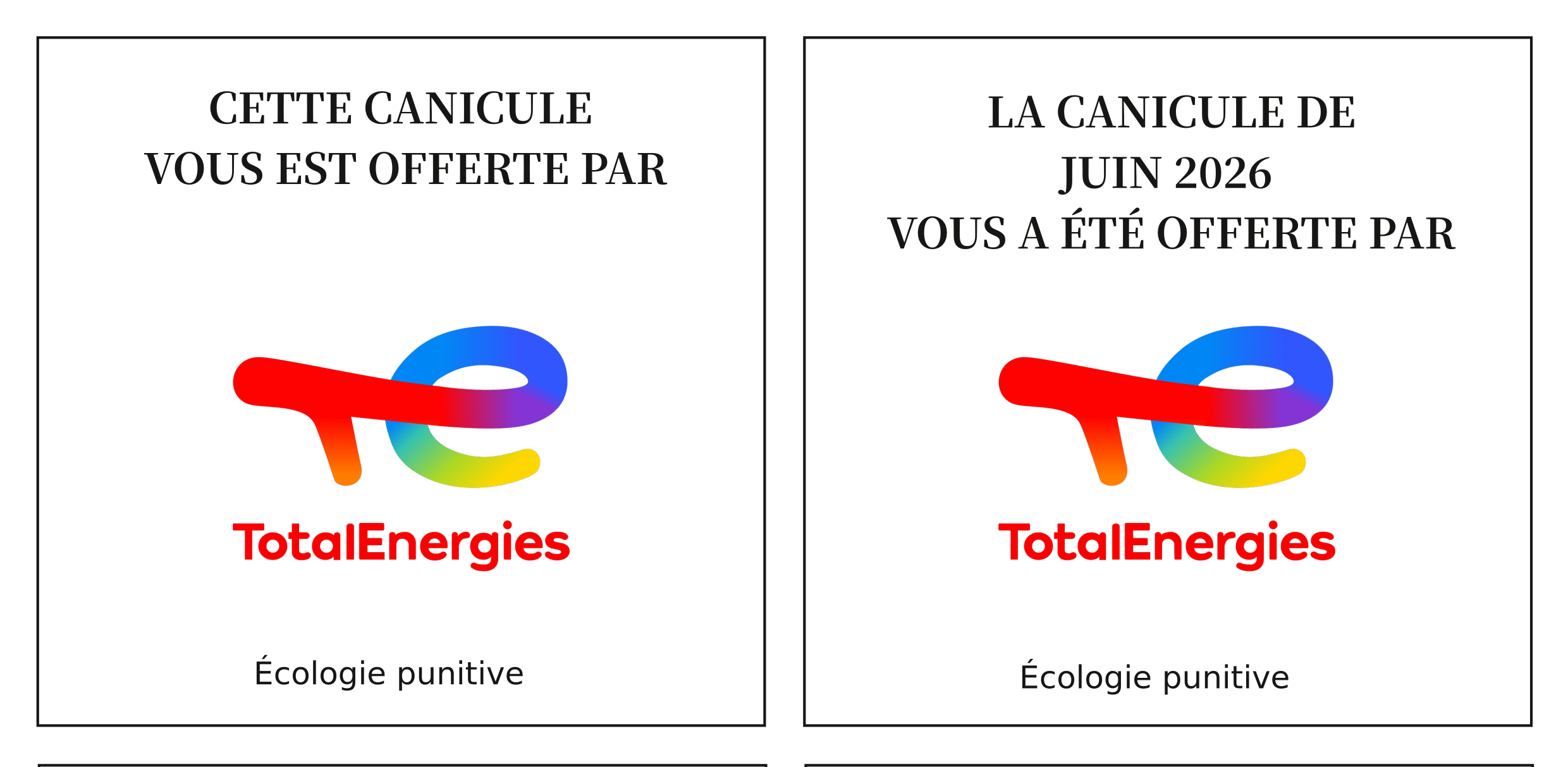
Il a également fait les stickers pour celle de mai :

Et il prévoit déjà celle de juillet :
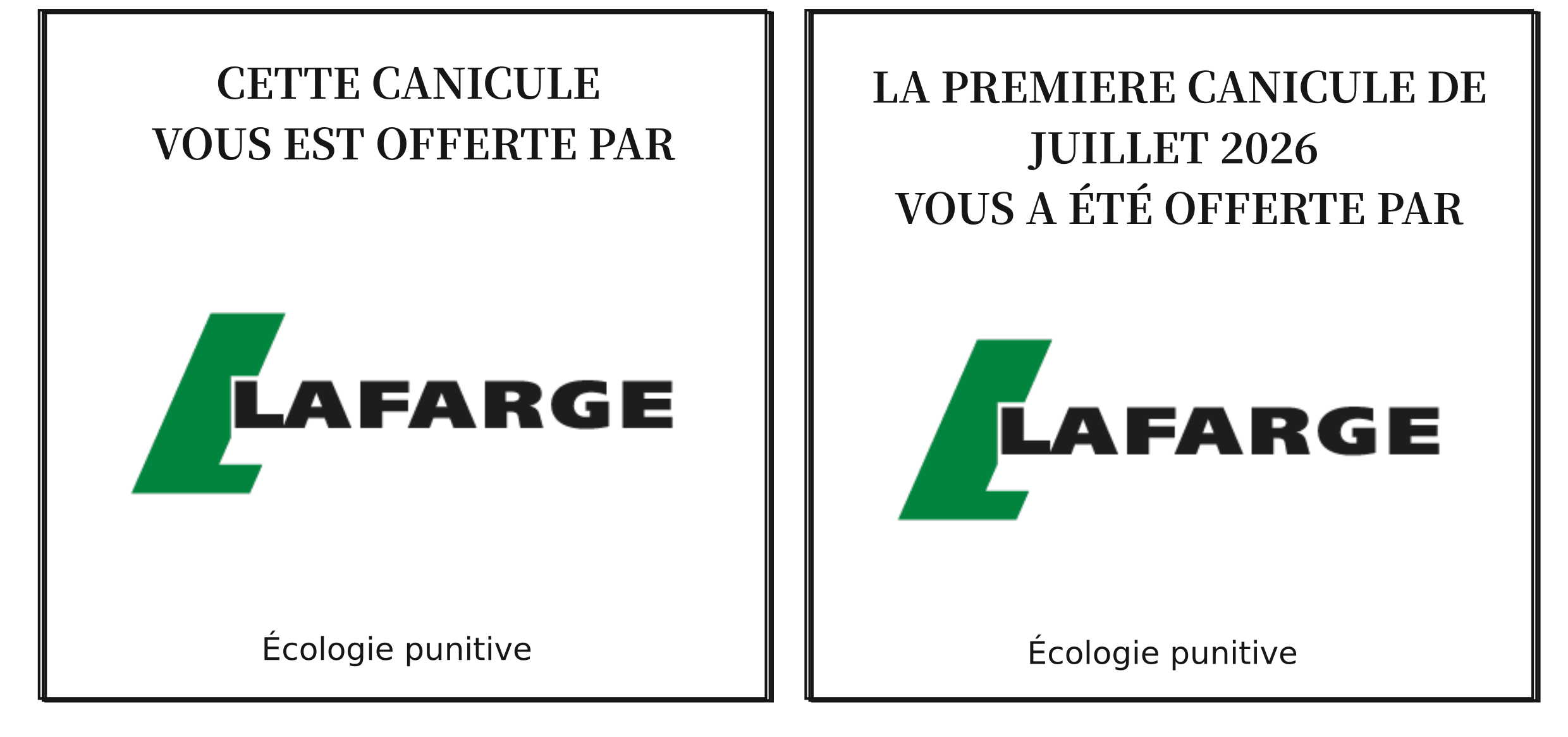
En 2026, TotalEnergies a clairement écrasé Bolloré. Lafarge pourra-t-elle tenir le niveau ? Rien n’est moins sûr, les supporters lancent déjà les paris.
Pour les prochains stickers, vous pouvez suivre Patlabar sur Mastodon:
PS: À propos de sponsor, l’équipe cycliste Israël-Startup Nation avait, en 2025, subit les foudres du public sur la Vuelta, entraînant son retrait de l’épreuve et le changement de sponsor pour 2026. Je me demande si on verra un jour des protestations similaires pour des équipes comme TotalEnergie ou Uno-X, qui sponsorisent le vélo en vendant de l’essence.
À propos de l’auteur :
Je suis Ploum et je viens de publier Bikepunk, une fable écolo-cycliste entièrement tapée sur une machine à écrire mécanique. Pour me soutenir, achetez mes livres (si possible chez votre libraire) !
Recevez directement par mail mes écrits en français et en anglais. Votre adresse ne sera jamais partagée. Vous pouvez également utiliser mon flux RSS francophone ou le flux RSS complet.
Publié le 01.06.2026 à 02:00
Qucocoma Philippe Samyn ?
J’apprends avec tristesse le décès de l’architecte Philippe Samyn, un esprit incroyable aux idées fulgurantes avec qui j’ai eu de longues et passionnantes discussions.
Car l’architecture était pour lui une porte d’entrée vers une compréhension plus globale du monde. Comme lorsqu’il m’a asséné :
— Le monde entier ne tourne qu’autour d’une seule et unique unité, qui est le cœur de tout.
— Euh, le dollar ?
— Tu me déçois Lionel ! C’est le joule bien entendu. Tout tourne autour du joule. Produire, stocker, échanger des joules. La monnaie internationale devrait être le joule ! Les puissants sont ceux qui exploitent la différence entre le dollar et le joule, les faibles ceux qui fournissent des joules pour rien ou si peu.
Ou cette discussion qui me revient régulièrement où il m’exposa que l’architecte devait construire des « ruines utiles ». Car un bâtiment ne va être utilisé que 50, 100 ou 300 ans. Mais ses ruines durent parfois 10 ou 100 fois plus longtemps. Certaines ruines dureront autant que la planète ! L’essentiel de la vie d’un bâtiment se fait à l’état de ruine et il faut le prévoir dès la conception.
Avant de le rencontrer, je n’avais jamais envisagé les choses sous cet angle. Ce qui m’a frappé en généralisant son discours, c’est à quel point le fait de tenter d’oublier l’étape des ruines est la maladie qui pourrit l’humanité tout entière à tous les niveaux.
Nous produisons, nous tentons de produire plus et plus rapidement sans jamais nous préoccuper de ce que nous allons faire de toute cette production. Nous en sommes au point d’automatiser la production d’images, d’écrits et de code informatique avec les chatbots sans nous poser la question des ruines que nous préparons.
Depuis plusieurs années, chaque fois que j’ai envie de me procurer un bien matériel, je me pose consciemment deux questions : « Où vais-je le ranger ? » et « Comment vais-je m’en débarrasser ? ». Penser consciemment à cette question au moment de l’achat rend l’achat en lui-même extrêmement anxiogène. Philippe Samyn avait lui poussé cette réflexion jusque dans la conception des bâtiments.
Mais l’ingénieur architecte était également un artiste attaché à son œuvre. Lorsque mon épouse et moi avons un jour critiqué « son » Aula Magna, bâtiment emblématique de Louvain-La-Neuve coincé entre un cinéma et un hôtel, il nous a déroulé, des larmes pleins les yeux, le plan de Louvain-la-Neuve tel qu’il l’avait imaginé et comment l’Aula Magna aurait du s’intégrer dans une superbe perspective bien plus vaste et cohérente. Une boule de colère et de tristesse dans la gorge, il nous a expliqué comment son projet avait été complètement dénaturé en n’en prenant qu’une partie et en l’encadrant d’autres immeubles qu’il trouvait hideux.
Philippe Samyn m’avait fait l’honneur de me compter parmi les bêta-lecteurs de l’œuvre de sa vie : un ouvrage exhaustif sur l’architecture et la société humaine, projet qu’il avait intitulé: « Qucocoma, Quoi Comment Construire Maintenant ».
Je lui avais prédit que cette œuvre risquait de ne jamais être achevée tant elle était ambitieuse, qu’il fallait absolument la publier par petite partie sous peine de laisser cette tâche à ses héritiers.
Je ne pensais pas avoir raison si tôt…
Philippe Samyn s’est éteint, mais le territoire reste à jamais marqué par ses idées.
À propos de l’auteur :
Je suis Ploum et je viens de publier Bikepunk, une fable écolo-cycliste entièrement tapée sur une machine à écrire mécanique. Pour me soutenir, achetez mes livres (si possible chez votre libraire) !
Recevez directement par mail mes écrits en français et en anglais. Votre adresse ne sera jamais partagée. Vous pouvez également utiliser mon flux RSS francophone ou le flux RSS complet.
Publié le 10.04.2026 à 02:00
Ne rien avoir à penser
Après le « Je n’ai rien à cacher », voici venu l’ère du « Je n’ai rien à penser »
Se faire prendre pour des crétins parce que ça fonctionne
Google l’annonce : il y a plus de personnes dans le monde avec un smartphone Android que de personnes qui ont accès à de l’eau propre et des égouts.
Cela implique, toujours selon Google, qu’il faut plus d’IA pour ces personnes.
Non, sérieusement, je ne déconne pas. C’est vraiment ce que les gens de Google vont raconter dans les universités dans des événements qui ressemblent un peu à ce que des vendeurs de cigarettes pourraient organiser dans des clubs de sport pour former la jeunesse à fumer en offrant un an de cigarettes gratuites.
Et ils enfoncent le clou: de toute façon, personne n’a le choix d’utiliser l’IA ou non. C’est comme ça. Exactement ce que disait Anthropic: « Que vous le vouliez ou non, préparez-vous pour ce monde stupide ! »
Mon exemple du vendeur de cigarettes semble exagéré, mais je viens d’être témoin, dans ma ville universitaire de Louvain-La-Neuve, d’une compétition qui consistait à faire le tour du lac en courant tout en buvant quatre bières de 33cl. La course était sponsorisée par… une marque de bière, bien entendu. L’université semble avoir donné sa bénédiction pour cet événement et beaucoup d’étudiants sont assez naïfs pour trouver ça cool…
Je suis moi-même un grand naïf. Je croyais que les personnes étaient majoritairement moralement « bonnes ». Elles produisent souvent un impact négatif lorsqu’elles travaillent à maximiser le profit d’une entreprise. C’est juste qu’elles ne s’en rendent pas compte.
Mais c’est faux. Nous savons aujourd’hui que des personnes comme Mark Zuckerberg sont tout simplement moralement inhumaines et que toutes les personnes impliquées savent très bien ce qu’elles font et pourquoi elles le font. Les produits Meta sont spécifiquement modifiés pour rendre les adolescents les plus addicts possibles, pour les perturber durant leur scolarité. Ce n’est pas une conséquence, c’est le but premier du produit. La distraction incessante n’est pas un effet insoupçonné, c’est littéralement ce que cherchent à faire les ingénieurs de Facebook.
Et dire que la plupart des profs sont en mode : « Il faut vivre avec, il faut apprendre à utiliser raisonnablement ».
Non. C’est faux et c’est complètement stupide. C’est comme donner aux adolescents des formations, sponsorisées par Philip Morris, où ils apprendraient à fumer « sans inhaler la fumée ». Ou leur dire que c’est cool de courir en buvant plus de bières que ton estomac ne peut en supporter.
La vérité c’est que la plupart des profs sont complètement addicts à leur smartphone et que c’est plus rassurant d’enseigner son addiction comme un truc positif que de se remettre en question.
La pub nous prend pour des crétins. Elle prend les politiciens pour des crétins. Et, expérimentalement parlant, elle a bien raison. Nous le sommes ! Ça fonctionne encore mieux que prévu parce que, du coup, nous allons leur donner raison et soutenir ceux qui se foutent de notre gueule !
Regardez le RGPD et les bannières de cookies qui ennuient tout le monde et pour lesquelles on accuse « l’Europe ».
Contrairement à une idée reçue, les ennuyeuses bannières de cookies sur les sites ne sont pas la faute du RGPD. D’ailleurs, dans l’immense majorité des cas, ces bannières sont illégales. Gee l’explique très bien en BD :
Mais il y a pire : si ces bannières sont ennuyeuses, c’est parce qu’elles ont été explicitement conçues pour ça. Et oui, pour faire baisser le degré d’adhésion du peuple envers le RGPD. C’est une pure manipulation politique volontaire et consciente de l’industrie publicitaire. Ils savent très bien ce qu’ils font : nous pourrir la vie pour décrédibiliser les institutions politiques afin de nous fourguer plus de pub.
La fin de l’intellectualisme
Un article important sur le retour à l’oralité et le déclin de la lecture. L’oralité, c’est l’émotion au lieu de l’information, c’est le charisme au lieu de la vérité, c’est la manipulation au lieu de la rationalité. C’est également la disparition de l’effort sur le long terme.
Cela semble alarmiste, mais, factuellement, lorsque les chercheurs scientifiques, censés représenter l’élite intellectuelle du monde, en sont réduits à générer des articles qui citent des articles qui n’existent pas, cela pose quand même des questions.
Oui, c’est la fin du monde, la fin d’un monde !
Mais ChatGPT n’est que la cerise sur le gâteau. La raison réelle, c’est que nous dévalorisons l’intellectualité depuis des décennies. Nous valorisons le CEO qui prend des décisions aléatoires en 5 minutes. Nous demandons à tout le monde de creuser des trous et de les reboucher pour « faire tourner l’économie ». Nous vivons dans un monde où Julius grimpe les échelons !
Bref, nous ne faisons que mener le monde vers sa destination la plus logique en regard des indicateurs que nous utilisons pour l’optimiser. C’est tout à fait normal. C’est tout à fait attendu. On ne réduira jamais les émissions de CO₂ tant qu’on tentera de maximiser le PIB d’un pays. Faire tourner l’économie implique de maximiser le travail et donc de consommer le plus de joules possible. Joules qu’il faut produire en émettant du CO₂. Les énergies dites « renouvelables » ne sont qu’une manière d’émettre « moins de CO₂ par joule ». Ce qui est une bonne chose en soi, mais ne résout pas le problème de base que nous cherchons justement à consommer le plus de joules possible. Le résultat du succès des énergies renouvelables est d’ailleurs évident : nous consommons plus de joules, tout simplement.
Nous sommes en train de connaître la fin de l’intellectualité comme nous avons traversé la fin de la vie privée. Non, ce n’est pas réellement la fin. C’est juste que l’intellectualité, tout comme la vie privée avant elle, a perdu son statut de valeur fondamentale pour devenir un truc underground, uniquement valorisée par quelques cercles de plus en plus considérés comme marginaux, y compris, surtout, au sein des plus prestigieuses institutions académiques.
« Je n’ai rien à cacher » s’est subtilement transformé en « Je n’ai rien à penser ».
Depuis les smartphones à ChatGPT en passant par les séries en streaming, les géants technologiques se sont ligués pour nous convaincre de ne plus penser, que penser est has been, que c’est fatigant, que ça ne sert à rien. Nul besoin d’avoir un doctorat en sciences politiques pour comprendre que ça arrange beaucoup de monde.
Ma défense : l’effet bibliothèque
Les chatbots ne font, au fond, qu’augmenter la disponibilité de l’information, y compris fausse. Cette disponibilité réduit l’engagement cognitif et donc le développement du cerveau. Cet effet était déjà visible et étudié en 2011 comme "l’effet Google". Si nous savons qu’une information est disponible en ligne, nous ne tentons plus de nous la rappeler, nous la cherchons (combien de fois avez-vous pris votre téléphone parce que vous ne vous souveniez plus du nom d’un acteur dans un film?)
Ce qui est amusant à constater c’est que, bien avant d’avoir lu ces études, j’ai instinctivement adopté la posture inverse depuis quelques années. Je me refuse de chercher immédiatement une info. Ma motivation était de ne pas interrompre une conversation en cours (je dissuade d’ailleurs mon interlocuteur de sortir son téléphone) ou ne pas interrompre mon travail en cours (je me connais, je sais que si je cherche l’info, je suis 30 minutes plus tard en train de lire la page Wikipédia consacrée à la biographie d’Henri IV ou à une espèce rare de méduse en Nouvelle-Calédonie).
On pourrait arguer qu’il en est de même avec une bibliothèque. Mais je vois des différences fondamentales.
Premièrement, il y a la composante physique : lorsque je cherche une information dans un livre, je me déplace, je cherche dans un rayon. Mon cerveau associe le mouvement avec la mémorisation. Ma bibliothèque a beau être fluide et mouvante, elle garde une structure. Avec le temps, se souvenir d’une information revient à se souvenir du déplacement à effectuer pour aller chercher le livre.
En second lieu, les informations dans les livres sont stables et figées. Elles peuvent être fausses, mais je sais qu’elles ne sont pas générées pour améliorer le SEO du livre ou obtenir des likes. Elles ne se transforment pas subitement en erreur 404.
Cette stabilité rassure mon cerveau. Celui-ci n’est pas dans la "perception", la tentative de comprendre un environnement changeant, ce qui est source de stress. Il est au contraire dans le familier et peut se permettre d’extrapoler, d’imaginer, de faire des liens imprévus.
Bref, je donne à mon cerveau la possibilité d’être créatif, je lui offre un espace stable où il peut expérimenter la mouvance et le changement dans ce qu’il crée : les mots, les histoires. Ce n’est pas un hasard si je n’écris que sur une machine à écrire ou depuis mon terminal dans un éditeur qui change très peu depuis 40 ans (Vim). Je veux libérer de l’espace mental pour créer et réfléchir.
Si vous avez déjà été dans une bibliothèque juste pour être au calme et réfléchir, vous voyez très bien ce que je veux dire.
Bref, je suis un technopunk ringard… Mais ça, vous le saviez déjà !
.jpg)
À propos de l’auteur :
Je suis Ploum et je viens de publier Bikepunk, une fable écolo-cycliste entièrement tapée sur une machine à écrire mécanique. Pour me soutenir, achetez mes livres (si possible chez votre libraire) !
Recevez directement par mail mes écrits en français et en anglais. Votre adresse ne sera jamais partagée. Vous pouvez également utiliser mon flux RSS francophone ou le flux RSS complet.
Publié le 03.04.2026 à 02:00
La première Madame Pipi de l’espace profond
Outre la première victoire au Tour de France d’Eddy Merckx, 1969 fut une année qui marqua trois événements très importants.
1. Le premier homme sur la Lune
2. L’invention du système UNIX
3. La naissance de Linus Torvalds.
Deux de ces événements ont encore aujourd’hui un impact quotidien dans votre vie.
Adolescent, j’étais fasciné par les vidéos de Neil Armstrong descendant l’échelle du module lunaire et faisant quelques pas. Je tentais d’imaginer ce que j’aurais ressenti si j’avais vécu cet instant. J’espérais d’ailleurs aller un jour moi-même dans l’espace.
Il y a 20 ans, je suivais en quasi direct la découverte de Titan par la sonde Huygens.
Aujourd’hui, pour la première fois depuis 1972, quatre humains ont quitté l’orbite basse terrestre et sont en route vers la Lune. Cela devrait être un truc incroyablement excitant. Mais comme le dit très bien Kevin Boone, tout le monde semble s’en foutre.
Kevin donne plusieurs explications : la catastrophe climatique et les guerres nous rendent beaucoup moins enthousiastes envers la technologie. Mais, surtout, notre attention est trop fragmentée pour nous rendre compte de l’exploit, pour nous y intéresser.
Among the many crimes that can be attributed to Google and the other tech giants, perhaps the worst is that they've created a world in which a Moon landing is unexciting.
Il n’empêche que quatre humains vont tourner autour de la Lune pour la première fois de mon vivant. Trois hommes et une femme, Christina Koch, qui est donc d’ores et déjà la femme la plus éloignée de la Terre de l’histoire de l’humanité.
Et devinez quel est le rôle de Christina à bord du vaisseau sachant qu’elle est l’astronaute la plus expérimentée des quatre ?
Je vous le donne en mille !
Elle est responsable des toilettes !
Je n’invente rien, je l’ai lu sur Wikipédia dans la section « Spécialiste de Mission 1 ».
Christina Koch est donc la première Madame Pipi de l’espace profond !
Ça semble terriblement sexiste, mais, en réalité, les toilettes sont réellement critiques dans l’espace. Les astronautes des missions Apollo déféquaient dans des sacs en plastique à l’étanchéité douteuse et les étrons flottants n’étaient pas rares. Il me semble avoir lu qu’un cas de diarrhée faillit causer l’annulation d’une des missions, car il y en avait partout.
Dans « Stagiaire au spatioport Omega 3000 », j’ironisais sur le fait que les femmes astronautes n’étaient pas prêtes à laisser la responsabilité d’être Madame Pipi à un homme.
À voir si, comme mon héros Nathan Pasavan, Chrisina Koch recevra à l’atterrissage l’emblématique cache-poussière rose et l’assiette à piécette, insigne historique de cette fonction honorifique…
Bref, pendant qu’ils tournent là-haut, je vous invite à (re)lire cette nouvelle et toutes les autres qui peuplent le recueil, dont « Les filons chocolatifères de la Lune », qui se passe également sur notre satellite.
- Présentation de Stagiaire au spatioport Omega 3000 (ploum.net)
- Commander Stagiaire au spatioport Omega 3000 (pvh-editions.com)
À propos de l’auteur :
Je suis Ploum et je viens de publier Bikepunk, une fable écolo-cycliste entièrement tapée sur une machine à écrire mécanique. Pour me soutenir, achetez mes livres (si possible chez votre libraire) !
Recevez directement par mail mes écrits en français et en anglais. Votre adresse ne sera jamais partagée. Vous pouvez également utiliser mon flux RSS francophone ou le flux RSS complet.
Publié le 26.03.2026 à 01:00
Le logiciel, un nouveau pétrole ?
Extrait de mon journal du 24 septembre 2025
Nous sommes fiers de nous passer de pétrole grâce à des panneaux solaires contrôlés par des logiciels… appartenant aux producteurs de pétrole !
On a parfois dit que le logiciel était « le nouveau pétrole ». C’est faux. La seule chose qui compte, c’est de contrôler, d’étrangler le monde en ne le laissant survivre qu’avec un fin filet d’air. Le pétrole était une ressource qui a été utilisée pour établir une dépendance. Le logiciel, lui, se passe de cet intermédiaire lorsqu’il est propriétaire.
Le logiciel propriétaire est le contrôle total par essence ! Il est cette chaîne magique que l’esclave ne peut jamais briser. Il n’est pas le pétrole, il est le besoin de pétrole !
À propos de l’auteur :
Je suis Ploum et je viens de publier Bikepunk, une fable écolo-cycliste entièrement tapée sur une machine à écrire mécanique. Pour me soutenir, achetez mes livres (si possible chez votre libraire) !
Recevez directement par mail mes écrits en français et en anglais. Votre adresse ne sera jamais partagée. Vous pouvez également utiliser mon flux RSS francophone ou le flux RSS complet.