
06.09.2026 à 19:26
Notre cerveau ne perçoit pas le monde de manière continue, mais par vagues
Camille Fakche, Post-doctorante en Neurosciences Cognitives, University of Birmingham
Laura Dugué, Professeure en neurosciences cognitives et computationnelles, Université Paris Cité
Texte intégral (2259 mots)
L’ESSENTIEL
Même si notre perception visuelle nous semble continue, elle est en réalité saccadée.
De nouvelles recherches démontrent que notre perception ne varie pas seulement dans le temps, mais aussi selon la position de l’information dans l’espace.
Ces recherches pourraient permettre d’améliorer les interfaces cerveau-machine.
En 1895, le premier film de l’histoire, Sortie d’usine, était projeté à Paris. Cette prouesse a été rendue possible par les frères Lumières, inventeurs du cinématographe, un appareil permettant de présenter 16 images par seconde, une fréquence suffisante pour nous donner une impression de fluidité, de continuité dans les mouvements lorsqu’on regarde le film.
À l’image des caméras vidéo fonctionnant sur la base d’une suite d’instantanés les uns à la suite des autres, notre cerveau prend des instantanés de notre environnement visuel, une dizaine par seconde, analysant le monde qui nous entoure de manière périodique.

Jusqu’au début du XXᵉ siècle, la perception était considérée comme continue. C’est dans les années 1900 que des psychologues expérimentaux (comme William James et Joseph Stroud) proposent l’hypothèse d’une perception périodique. Au cours d’un cycle de 100 millisecondes (ms), notre cerveau est plus réceptif au sommet du cycle : il traite mieux les informations visuelles, comme si tout était plus clair et visible. À l’inverse, lorsqu’il est dans le creux du cycle, les informations visuelles sont moins bien perçues, parfois manquées complètement, comme si elles étaient plongées dans l’ombre (Figure 1).

Récemment, nous avons montré dans notre laboratoire que notre perception ne varie pas seulement dans le temps, mais aussi selon la position de l’information dans l’espace. Elle agit comme une vague qui se déplace dans notre champ visuel, rendant certains endroits plus visibles que d’autres selon le moment où la vague les atteint. Lorsqu’une goutte tombe dans de l’eau, elle induit des cercles qui se propagent tout autour du point d’impact. De la même façon, à partir d’un point de référence dans notre environnement, des vagues perceptives se propagent autour de nous. Là où la vague atteint son sommet, notre perception est particulièrement précise. En revanche, dans le creux de la vague, notre perception est limitée (Figure 2).
Comment montrer l’existence de vagues de perception ?
En laboratoire, nous avons plusieurs outils pour comprendre les mécanismes liant cerveau et perception. On peut utiliser des méthodes pour enregistrer l’activité de notre cerveau et ainsi la relier à nos capacités perceptives. Il est également possible d’utiliser des méthodes de mesure du comportement uniquement. Voici comment nous avons procédé.
Notre cerveau analyse l’environnement visuel à une fréquence d’environ 10 hertz (Hz), en réalisant des instantanés de notre monde environ 10 fois par seconde. Cette fréquence d’échantillonnage varie toutefois selon les individus, généralement entre 8 et 12 Hz. Des chercheurs ont raisonné que si notre perception est cyclique, alors il est vraisemblable que l’activité cérébrale qui sous-tend notre perception est cyclique elle aussi.
De nombreuses expériences ont permis de valider et de confirmer cette théorie : les populations de neurones qui traitent les informations visuelles produisent elles aussi une activité électrique cyclique à 10 Hz. Cette activité, appelée oscillation cérébrale, peut être enregistrée en plaçant des électrodes sur le cuir chevelu (électro-encéphalogramme, EEG). Lorsqu’une information visuelle est présentée au sommet de l’oscillation produite par nos neurones, alors elle est bien perçue, tandis que si elle est présentée au creux, elle est moins bien perçue (Figure 1). Bien que cet article se concentre sur la modalité visuelle, les sensations auditives et tactiles seraient elles aussi traitées de manière périodique plutôt que strictement continue.
Au laboratoire, nous pouvons générer, contrôler, et mesurer les cycles de notre perception. Pour cela, dans une pièce sombre, nous présentons un disque qui clignote à une fréquence de 10 Hz sur un écran d’ordinateur. Cette modulation cyclique du stimulus visuel va produire une activité cérébrale cyclique à la même fréquence, c’est-à-dire une oscillation à 10 Hz. Ainsi, la perception d’information visuelle à proximité du disque clignotant va dépendre du cycle de l’oscillation cérébrale.
Cette manipulation expérimentale nous permet non seulement de mesurer les cycles de notre perception, mais nous pouvons également savoir quelles populations de neurones de notre cerveau entrent en jeu. En effet, les aires cérébrales qui traitent l’information visuelle sont très bien organisées, comme des cartes topographiques de notre champ visuel. Chaque neurone de chaque région visuelle a la mission de traiter une zone précise de notre champ visuel. Comme si notre champ visuel était divisé en milliers de petites cases, chacune gérée par un neurone différent.
Plus important, deux populations de neurones qui sont juste à côté l’une de l’autre dans une région visuelle vont traiter les informations en provenance de deux endroits qui sont juste à côté dans le champ visuel. Ce principe d’organisation est appelé rétinotopie, et grâce à ce principe, nous savons quelles populations de neurones vont suivre l’oscillation du disque clignotant en bas à droite de l’écran (il s’agira des régions visuelles dorsales de l’hémisphère gauche).
Au laboratoire nous pouvons induire une activité cérébrale à une fréquence de 10 Hz, avec une origine précise dans les aires visuelles. La question que nous nous sommes posées est la suivante : les oscillations à 10 Hz induites par le disque dans des neurones spécifiques se propagent-elles aux neurones adjacents comme une vague, à l’image de la goutte qui tombe dans l’eau ?
Prenons deux objets que nous pouvons retrouver sur notre espace de travail : une tasse à café et un clavier d’ordinateur (Figure 2). Si l’activité cérébrale se propage comme une vague, alors à un moment donné, la perception de la tasse à café sera meilleure que celle du clavier ; et l’inverse se produira à un autre moment dans le temps (l’hypothèse alternative où il n’y a pas de vague est présentée en Figure 3). Rappelons que notre perception évolue à une échelle de temps très rapide, de l’ordre d’un millième de seconde. Comme lorsque nous regardons un film, ces variations se produisent si vite que nous n’en avons pas conscience. Pourtant, elles influencent ce que nous voyons à chaque instant.
Nous avons répliqué ce principe en laboratoire. Nous avons présenté à des participants un disque clignotant à une fréquence de 10 Hz, ainsi que des petits points blancs à différentes positions dans l’espace et à différents temps (Figure 4). La tâche des participants est simple, il leur est demandé d’appuyer sur un bouton du clavier lorsqu’un des points est vu. Nos résultats ont montré que la perception n’est pas la même pour les trois points à un moment donné.
En effet, il y a un décalage de 5 ms entre la meilleure perception des points. Par exemple, si la perception est meilleure à 100 ms pour le point 1, elle sera meilleure à 105 ms pour le point 2, et à 110 ms pour le point 3. Ce résultat nous permet de conclure que l’activité cérébrale dans les aires visuelles est dynamique. Elle se propage de son point d’origine vers les autres points à une vitesse de 0,5 m/s, de même que la perception visuelle.
Bien que notre perception semble être périodique, nous avons une impression de continuité visuelle. On ne sait pas encore précisément comment cette continuité émerge. Les mouvements rapides des yeux (les saccades) jouent probablement un rôle important.
Entre deux fixations, le cerveau semble conserver une partie des informations déjà acquises, un phénomène appelé mémoire transsaccadique, afin de maintenir une représentation stable de la scène visuelle. Cette mémoire, associée à l’intégration des informations visuelles au cours du temps, pourrait contribuer à notre impression d’un monde fluide et continu, mais la contribution exacte de ces différents mécanismes reste un sujet de recherche.
Vers des applications dans le domaine des interfaces cerveau-machine
Pendant longtemps, les chercheurs qui étudient la vision se sont principalement intéressés à la manière dont l’activité du cerveau change dans le temps pour expliquer la perception. Nous savons à présent que l’activité cérébrale se propage de manière dynamique à travers le cerveau.
Au-delà de mieux comprendre les mécanismes fondamentaux de notre cerveau, cette connaissance va nous permettre d’améliorer des techniques de réhabilitation pour les patients. Par exemple, les interfaces cerveau-machine permettent de mesurer l’activité cérébrale au niveau des aires motrices de patients para- ou tétraplégiques, pour ensuite envoyer une commande à une prothèse pour réaliser un mouvement. En mesurant l’activité cérébrale au bon moment et au bon endroit, il sera possible de réaliser des mouvements avec une plus grande précision.
Enfin, nous avons réussi à révéler l’aspect dynamique de l’activité cérébrale… sans jamais poser un seul capteur pour enregistrer le signal du cerveau. Par la seule précision de protocoles bien conçus, l’expérimentation comportementale nous permet d’entrevoir les lois qui régissent notre perception. Ainsi, derrière l’apparente simplicité de certaines expériences se cache un véritable pouvoir : celui de révéler, avec finesse, les secrets invisibles de notre cerveau.

Laura Dugué a reçu un financement de l'ERC (N° 852139). Elle est membre honoraire de l'IUF.
Camille Fakche ne travaille pas, ne conseille pas, ne possède pas de parts, ne reçoit pas de fonds d'une organisation qui pourrait tirer profit de cet article, et n'a déclaré aucune autre affiliation que son organisme de recherche.
06.09.2026 à 19:25
Galileo, Copernicus, Cleansky, IRIS² must work together to secure Europe’s place in the space race
Audrey Rouyre, Enseignante-chercheuse en Management Stratégique, Montpellier Business School, Montpellier Business School; European Academy of Management (EURAM)
Anne-Sophie Fernandez, Professeur des Universités, Université de Montpellier; European Academy of Management (EURAM)
Texte intégral (2844 mots)
“Seeing the Earth from above is a powerful reminder of our interdependence,” Thomas Pesquet. The words of France’s tenth astronaut to head into Space are a reminder of how we are “in this together”, something that the world’s Aerospace industry players should take heed of as they gather in Paris for the first-ever International Space Summit between September 9-10th.
The event is a prime occasion for showcasing Europe’s ambitions in orbit, namely France’s National Space Strategy 2025-2040, but the summit more importantly underscores a lesson from Europe’s space history: its greatest successes have come through cooperation, not countries acting alone. As competition in space intensifies, that collective strength may matter more than ever.
A new space race is under way, and the nature not just the scale of it is changing. The sector is entering an era marked by intensifying rivalry between EU member states – but also by an unprecedented degree of industrial and technological interdependence. For Europe, it’s not about managing a contradiction; it’s about taking the only viable path forward. The continent’s space ambitions, and ultimately its strategic autonomy, now depend on a single underlying mechanism: multilateral “coopetition,” a deliberate blend of cooperation and competition between several rivals.
Four flagship European programmes – Galileo, Copernicus, Clean Sky, and IRIS² – show why collaboration, not national or corporate self-sufficiency, has become Europe’s only realistic route to sovereignty in space.
Nearly $137 billion: that is the record level of global space spending in 2025, announced at the France’s 14th Perspectives spatiales conference, which gathers institutional, industrial, and academic players from across the sector. This colossal sum is sharpening appetites everywhere. But it is also exposing a structural truth: mastering the entire space value chain is now beyond the reach of any single state, agency, or company – including the most powerful ones.
Even Europe’s largest industrial players are compelled to work with their direct competitors.
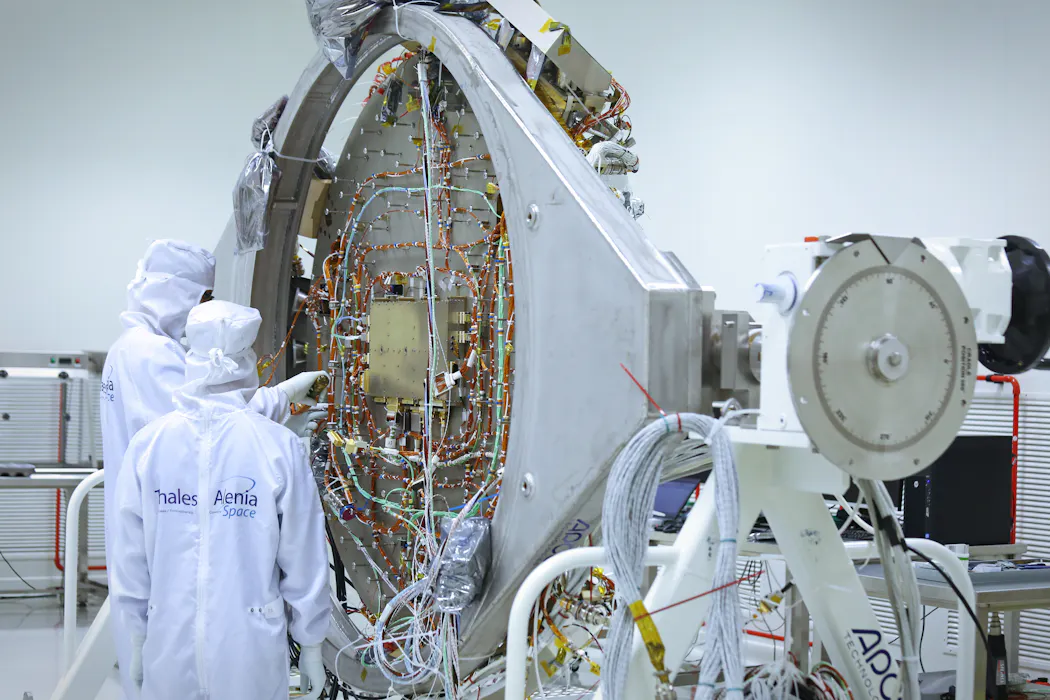
French firm Thales Alenia Space and Germany’s OHB System are jointly developing radar instruments for the European Space Agency’s (ESA) Harmony mission, which monitors changes in the Earth’s shape. More recently, Dassault Aviation and OHB System joined forces to pitch ESA a multipurpose space plane, VORTEX-S.
These are not isolated alliances of convenience. They are the visible tip of a much deeper European strategic shift: from competing for sovereignty to building, it together.
To understand this shift, we studied the actors involved between 2017 and 2026 in four landmark European programmes:
Galileo (Europe’s own satellite positioning system)
Copernicus (the EU’s satellite Earth-observation system)
The Clean Sky network (sustainable, climate-neutral aviation)
IRIS² (the EU’s forthcoming secure satellite telecommunications constellation).
Together, they form the clearest evidence yet that Europe’s future in space and arguably its future as a sovereign technological power, will be written collectively, or not at all.
A new strategic standard for European sovereignty
Coopetition rests on a paradoxical logic: actors competing for the same markets simultaneously agree to cooperate on parts of their activity.
For decades, management sciences scholars mainly studied it as a relationship between two rival firms. The European space sector tells a different story – one of multilateral coopetition, involving states, agencies, large industrial groups, SMEs, and start-ups, all of them competitors to varying degrees, all of them needing each other.


À lire aussi : Carbon capture explained: how EU member states are funding and rolling out the technology to clean up Europe’s fossil fuel industry
Copernicus is the clearest illustration of this. The EU Earth observation programme tracks emissions, land use, forests, oceans and ice. It is run by the European Commission along with the European Space Agency, EUMETSAT, and other partners; and operates using satellite technology to provide free, very high quality imagery. This open infrastructure lets European SMEs and start-ups build commercial services such as crop monitoring, methane-leak detection, forest surveillance – without ever having to fund their own satellite program. It is a European public investment that directly qualifies as private European innovation, at a scale no single member state could replicate alone.
IRIS², Europe’s new flagship satellite constellation programme, pushes the model further still. It brings together three competing European operators – France’s Eutelsat, Luxembourg-based SES, and Spain’s Hispasat – united under the SpaceRISE consortium specifically to guarantee Europe its own secure, sovereign communications infrastructure, independent of non-European systems.
The message is unambiguous: European digital and strategic sovereignty is being built through alliance between rivals, not in spite of it.
The European Space Agency as sovereignty’s orchestrator
Our research shows that the knowledge-sharing problem at the heart of coopetition can become so complex that a trusted third party is needed to hold the system together. In Europe’s case, that role falls on the European Space Agency.
ESA occupies a unique dual position: it is both the programme owner for financing projects, and setting specifications for example, and a technical prime contractor which steers satellite development alongside industry. This dual mandate gives ESA a power of orchestration that no purely national agency or single company could exercise alone.
In Galileo, competing manufacturers were reluctant to share certain critical knowledge directly with each other.
ESA stepped into that gap: each company shared its knowledge with the agency, which filtered, aggregated, and redistributed what each partner needed. Without that European-level centralising function, Europe’s GPS simply would not exist.
What multilateral coopetition delivers for Europe
Our diverse studies point to three concrete benefits that explain why Europe keeps choosing this model for its flagship programmes.
Reaching a critical mass Multilateral coopetition lets Europe tackle technological challenges no single actor could meet, by pooling financial, technological, and human resources at continental scale. The main satellite constellation could never have been built without combining the expertise of Europe’s entire space industry – it is, quite literally, a sovereignty project that only exists because competitors cooperated.
Sharing valuable and strategic knowledge
Coupled innovation projects between competitors depend on sharing heterogeneous, complementary knowledge. Without that sharing, the project fails outright – there is no fallback for national self-sufficiency.
Reducing the risks and costs associated with innovation development
In long horizon, high-stakes programmes like Galileo or IRIS, coopetition spreads each company’s exposure to technological and financial risk across the whole consortium – a mechanism long identified as one of coopetition’s founding drivers, and one Europe now relies on structurally.
Management is the real key to coopetition and sovereignty
None of this is a smooth ride.
Multilateral coopetition generates real tension. As the number of partners grows, power dynamics get harder to manage: coalitions form, hidden opportunism creeps in, knowledge gets misappropriated, and value sharing becomes unbalanced. These risks already exist between two competitors; multilateral coopetition amplifies them. Yet management sciences research on bilateral coopetition insights cannot be transposed to managing multilateral coopetition at the scale Europe now needs.
Our research points to a specific answer: project teams, built across competing organisations, that facilitate knowledge sharing and technical compatibility while still protecting each partner’s competitiveness. More broadly, every one of Europe’s successful programmes converges on the same hybrid management model – formal mechanisms (contracts, governance rules, IP arrangements) combined with informal ones (trust, personal relationships, shared professional norms). It is this combination, not contracts alone, that keeps cooperation and competition in balance.
Clean Sky is a striking case. This €5 billion programme aims to cut aircraft CO₂ emissions, nitrogen-oxide emissions, and noise. Eleven competitors – Airbus, Safran, Dassault, and others – sit around the same table at the Network Management Office, where technological priorities, budgets, and IP rules are all formally set out. But on the ground, contracts only go so far. Project leaders talk daily, know each other, and trust each other; over time, shared habits define what can be said openly and what stays confidential. That informal layer of trust is itself a European strategic asset – one that cannot be legislated into existence, only built over years of joint programmes.
A community of passionate European space professionals
Individuals are the ones who actually make this work.
Engineers, project managers, and program directors navigate daily between loyalty to their own organisation and the collective imperative of the programmes, managing the tensions that coopetition inevitably produces.
This is especially visible in the European space sector, which remains, at its core, a community of passionate people who often know each other, have frequently worked together before, and share – beyond their corporate or national rivalries – a common ambition to advance European space and see it succeed on the world stage. That shared identity is arguably as important to European sovereignty as any single satellite or constellation.
Multilateral coopetition: the precondition for Europe space leadership
Managing multilateral coopetition effectively is a prerequisite for European leadership in space. The states and companies that master it are the ones positioned to secure Europe’s place in the next phase of the space race.
The stakes extend well beyond industrial performance: in a world where space data increasingly underpins agriculture, defence, and climate action, mastering coopetition is mastering sovereignty.
That is the wager behind every one of Europe’s flagship programmes: Galileo for navigation, Copernicus for Earth observation, IRIS² for secure communications, Clean Sky for the aviation of tomorrow. Each one is, in its own way, proof that for Europe, there is no sovereign future in space if it’s not a collaborative effort.

A weekly e-mail in English featuring expertise from scholars and researchers. It provides an introduction to the diversity of research coming out of the continent and considers some of the key issues facing European countries. Get the newsletter!

Audrey Rouyre heads Aerospace activities within Chaire Pégase, (the first French chair dedicated to the economics and management of air transport, tourism and the aerospace sector) and is Vice-Chair of the Aviation and Space Affairs Committee of the INAS (National Institute for Strategic Affairs).
Anne-Sophie Fernandez ne travaille pas, ne conseille pas, ne possède pas de parts, ne reçoit pas de fonds d'une organisation qui pourrait tirer profit de cet article, et n'a déclaré aucune autre affiliation que son organisme de recherche.
05.09.2026 à 17:13
Vers un ciel artificiel ? Ce que prévoit le droit contre la pollution du ciel nocturne
Anna Hurova, Post-doctorante, Chaire Espace, École normale supérieure (ENS) – PSL
Texte intégral (2045 mots)
L’ESSENTIEL
L’explosion en cours du nombre de satellites vient s’ajouter à la pollution lumineuse que nous émettons depuis la surface de la Terre et menace la noirceur du ciel nocturne.
Si la pollution lumineuse sur Terre peut être encadrée, et l’est d’ailleurs plutôt bien en France, la pollution lumineuse venant de l’espace est bien plus difficile à réguler. Les juristes sont à pied d’œuvre.
Saviez-vous que, dans certains pays comme le Japon, il existe des parcs naturels… astronomiques ?
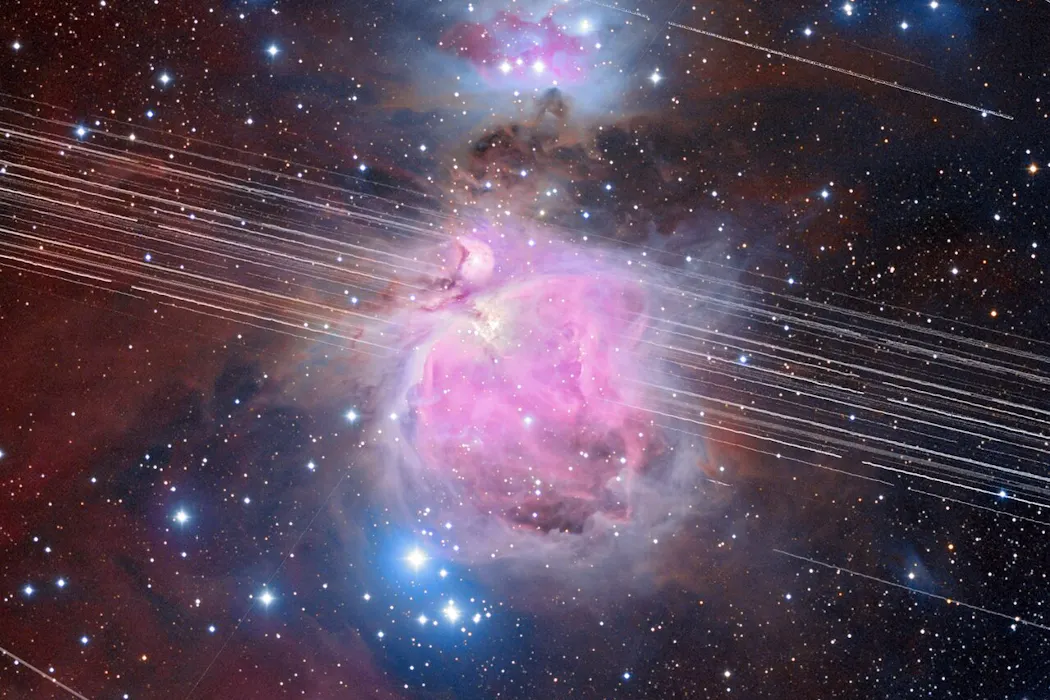
Chaque année, au mois d’août, a lieu l’une des plus grandes pluies d’étoiles filantes de l’année : les Perséides. Mais si vous observez le ciel nocturne l’an prochain, que pourrez-vous voir ? Selon l’endroit où vous vous trouvez, peut-être juste un ciel gris ou orangé sur lequel vous apercevrez la constellation de la Grande Ourse, et surtout de points lumineux en mouvement, qui sont autant de satellites « en orbite basse ».
À lire aussi : Notre ciel nocturne est en train de disparaître : un des enjeux du Sommet international sur l’espace 2026
Aujourd’hui, il existe deux sources principales de pollution lumineuse du ciel nocturne, qui limite toujours davantage un accès libre et ouvert au ciel nocturne : celles provenant de la Terre et celles provenant de l’espace, en particulier des satellites. Que dit le droit de la protection de la nuit étoilée ?
Protection contre la pollution lumineuse d’origine terrestre : l’approche française
La première source est relativement mieux réglementée. L’Association nationale pour la protection du ciel et de l’environnement nocturnes (ANPCEN) définit le phénomène comme « la dégradation de l’environnement nocturne par émission de lumière artificielle entraînant des impacts importants sur les écosystèmes (faune et flore) et sur la santé humaine suite à l’artificialisation de la nuit ».
En France, depuis moins d’une décennie, plusieurs dispositions encadrent la pollution lumineuse. Notamment, le Code de l’environnement vise à assurer un équilibre harmonieux entre les zones urbaines et les zones rurales et encadre les émissions lumineuses artificielles. De plus, un décret de 2022 vise à réduire et prévenir la pollution lumineuse, en précisant les exigences relatives à la conception et à l’exploitation des installations d’éclairage extérieur ainsi que les règles applicables aux propriétaires publics et privés. Un arrêté fixe quant à lui la liste et le périmètre des 11 sites d’observation astronomique exceptionnels.
À lire aussi : Éclairage public : les Français sont-ils prêts à éteindre la lumière ?
Un mécanisme non gouvernemental de portée internationale est le label « Réserve internationale de ciel étoilé » (RICE), décerné par l’International Dark Sky Association, basée aux États-Unis. Ce label récompense une qualité exceptionnelle du ciel nocturne et engage les territoires concernés à mettre en œuvre des actions visant à réduire la pollution lumineuse. Il en existe sept en France, mais les RICE ne bénéficient d’aucune reconnaissance officielle de la part de l’État, ce qui limite leur capacité à se développer et à influencer les politiques publiques.
Par conséquent, la ministre de la transition écologique, de la biodiversité et des négociations internationales sur le climat et la nature a reçu d’une sénatrice des Alpes-Maritimes une question portant sur la reconnaissance officielle des RICE comme territoires d’intérêt national, ainsi que sur l’élargissement du champ de l’arrêté aux éclairages privés.
Si l’on compare la France à d’autres États, elle figure parmi les pays les plus avancés en matière de lutte contre la pollution lumineuse. Les États réglementent principalement cette question au moyen de seuils d’éclairage, de restrictions techniques applicables aux installations lumineuses au niveau des différentes unités administratives, de réglementations techniques spécifiques (comme en Italie), ou encore par la certification de certains parcs nationaux en tant qu’« International Dark Sky Places », comme c’est notamment le cas au Japon.
Une pollution lumineuse sans frontières : le rôle des satellites
La pollution provenant de l’espace est due aux satellites qui réfléchissent la lumière du soleil.
La plupart des satellites polluent de façon « accidentelle ». En effet, les satellites sont construits à partir de matériaux qui réfléchissent la lumière du soleil, ce qui les rend souvent visibles à l’œil nu, sans qu’ils soient conçus spécifiquement pour cela. Le nombre de satellites en orbite autour de la Terre a connu une croissance exponentielle ces dernières années. En 2026, environ 15 000 satellites sont en orbite basse (low Earth orbit, ou LEO). Ils ont un impact direct sur l’astronomie professionnelle et amateur (contrairement aux satellites opérant sur d’autres orbites).
L’effet combiné des satellites actuellement en orbite basse et de l’accumulation de débris spatiaux pourrait déjà entraîner une augmentation d’environ 10 % de la luminosité du ciel nocturne par rapport aux niveaux naturels.
La régulation des satellites « pollueurs accidentels »
La régulation de ce domaine repose sur l’interaction entre trois catégories d’acteurs.
Les sociétés et organisations astronomiques encouragent les entreprises à coopérer et à partager leurs solutions afin de préserver les intérêts de l’astronomie. Elles incitent également les États à mettre en place des mesures incitatives visant à aider les opérateurs de satellites à développer les technologies nécessaires pour réduire au maximum les interférences avec les observations astronomiques et préserver la qualité du ciel nocturne, notamment son caractère sombre et silencieux.
Ainsi, le Centre de l’Union astronomique internationale pour la protection du ciel sombre et silencieux contre les interférences des constellations de satellites (IAU CPS) élabore notamment, en collaboration avec les opérateurs, des recommandations techniques, par exemple concernant les limites de luminosité apparente des satellites.
Il mène également des consultations avec des organisations internationales, telles que l’Union internationale des télécommunications (UIT) et le Bureau des Nations unies pour les affaires spatiales (UNOOSA), ainsi qu’avec les gouvernements nationaux, afin de favoriser la mise en œuvre des instruments existants de soft law, tels que les Best Practices for the Sustainability of Space Operations de la Space Safety Coalition, le Code of Conduct for Space Sustainability de la Global Satellite Operators Association ou encore l’ESA Zero Debris Charter.
La pollution lumineuse intentionnelle, une source émergente et très inquiétante
La pollution lumineuse intentionnelle, quant à elle, est étroitement liée aux projets de réflecteurs solaires.
En effet, en juillet 2026, la Commission fédérale des communications (FCC) des États-Unis a accordé à la société Reflect Orbital une autorisation pour le développement d’une technologie de réflecteurs spatiaux destinés à diriger la lumière solaire réfléchie vers des zones ciblées afin de « fournir une solution d’éclairage pour les opérations critiques » sans précision sur la nature de ces opérations, celles-ci sont probablement liées à l’augmentation de la durée d’utilisation des cellules solaires.
Ce dernier exemple a relancé les débats scientifiques et soulève trois questions juridiques :
1) Cette pratique, en l’absence de normes réglementaires spécifiques, pourrait-elle contribuer à l’émergence d’une pratique coutumière, autrement dit, il s’agirait d’un mode d’action déterminé par une pratique établie, plutôt que par des normes juridiques ? Pour répondre la question, il faudrait une communication publique et transparente concernant ces technologies, avant leur mise en œuvre. Celle-ci permettrait de renforcer la prise de conscience internationale et de garantir une implication active des États dans d’élaboration des normes (un mécanisme prévu par l’article IX du Traité de l’espace).
2) Existe-t-il une perspective d’adoption par les États membres des Nations unies de la proposition de moratoire ? Il semble qu’un document unilatéral tel qu’un moratoire risquerait de demeurer peu uniforme et de conduire à une approche réglementaire asymétrique entre les États, créant ainsi une fragmentation supplémentaire de la gouvernance des nouvelles activités spatiales.
3) La lumière solaire peut-elle être considérée comme une « substance extraterrestre », au sens de l’article IX du Traité de l’espace – ce qui permettrait l’application de cette disposition aux réflecteurs orbitaux ? Par analogie avec les échantillons d’astéroïdes, la lumière solaire qui n’atteindrait pas naturellement certaines zones de la Terre, mais qui serait intentionnellement dirigée par une intervention humaine, pourrait être considérée comme une substance extraterrestre au sens de l’article IX du Traité de l’espace, qui oblige les États parties au Traité à éviter les modifications nocives du milieu terrestre et à prendre les mesures appropriées à cette fin comme l’engagement dans les consultations internationales.
Une coordination renforcée entre les opérateurs de satellites, les astronomes et les autorités publiques est indispensable pour protéger le ciel nocturne contre les pollutions lumineuses, quelle qu’en soit la source. Et même chacun d’entre nous, qui sommes à la fois des contemplateurs du ciel nocturne et des utilisateurs de services spatiaux, peut contribuer à sa protection par un engagement citoyen actif.

Anna Hurova ne travaille pas, ne conseille pas, ne possède pas de parts, ne reçoit pas de fonds d'une organisation qui pourrait tirer profit de cet article, et n'a déclaré aucune autre affiliation que son organisme de recherche.
- GÉNÉRALISTES
- Ballast
- Fakir
- Interstices
- Issues
- Korii
- Lava
- La revue des médias
- Time France
- Mouais
- Multitudes
- Positivr
- Regards
- Slate
- Smolny
- Socialter
- UPMagazine
- Le Zéphyr
- Idées ‧ Politique ‧ A à F
- Accattone
- À Contretemps
- Alter-éditions
- Contre-Attaque
- Contretemps
- CQFD
- Comptoir (Le)
- Déferlante (La)
- Esprit
- Frustration
- Idées ‧ Politique ‧ i à z
- L'Intimiste
- Jef Klak
- Lignes de Crêtes
- NonFiction
- Nouveaux Cahiers du Socialisme
- ✝ Période
- ARTS
- Beaux Arts
- L'Autre Quotidien
- Recours au poème
- Villa Albertine
- THINK-TANKS
- Fondation Copernic
- Institut La Boétie
- Institut Rousseau
- TECH
- Dans les algorithmes
- Framablog
- Goodtech.info
- Libre à lire (April)
- Quadrature du Net
- Revue Eur. Médias et Numérique
- INTERNATIONAL
- Alencontre
- Alterinfos
- Gauche.Media
- CETRI
- ESSF
- Inprecor
- Guitinews
- MULTILINGUES
- Kedistan
- Quatrième Internationale
- Viewpoint Magazine
- +972 mag
- PODCASTS
- Arrêt sur Images
- Le Diplo
- LSD
- Thinkerview