11.08.2026 à 00:44
Alleged cartel boss Daniel Kinahan charged in Ireland following high security extradition
Fergus Shiel
Texte intégral (798 mots)
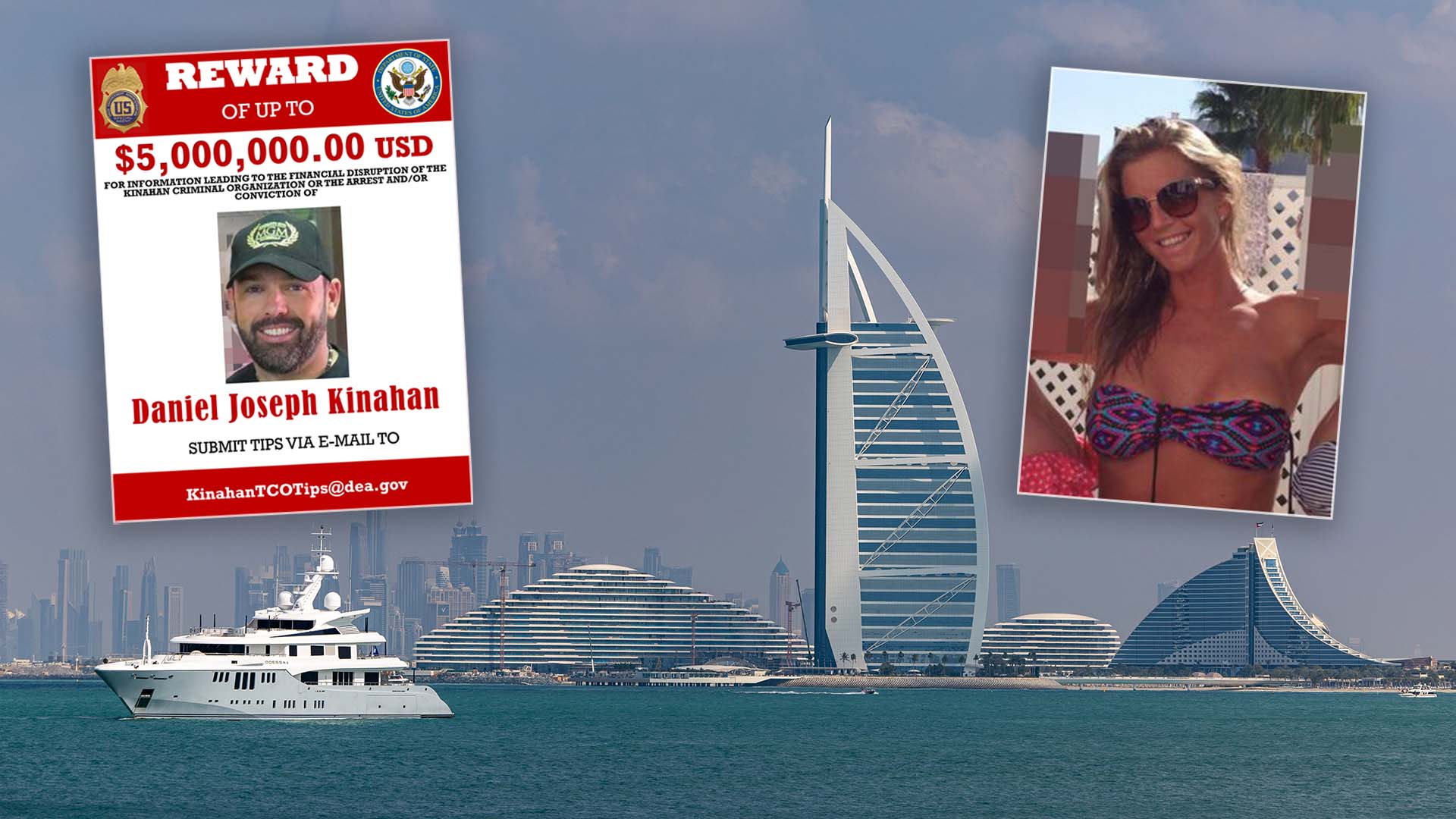
Boxing promoter Daniel Kinahan has been charged with directing the activities of a criminal organization after being extradited from Dubai to his native Ireland amid a huge security operation.
Authorities allege that Kinahan, 49, oversaw a global narco-trafficking operation that was tied to a bloody gang war in Ireland that resulted in numerous killings.
Kinahan was taken to the Special Criminal Court in Dublin under armed escort after being flown to an aerodrome west of the city on a Dassault Falcon 6X by the Irish Air Corps.
Unrepresented in court, he was ordered to remain in custody at Portlaoise Prison, a high-security prison about 90 miles south of the capital.
Ahead of his return, Kinahan reportedly told podcaster James English that he was “looking forward to getting home,” although conceded his return would be “bittersweet.”
Daniel Kinahan’s father, Kinahan cartel founder Christopher Sr, and brother, Christopher Jr, remain in Dubai despite being global law enforcement targets.
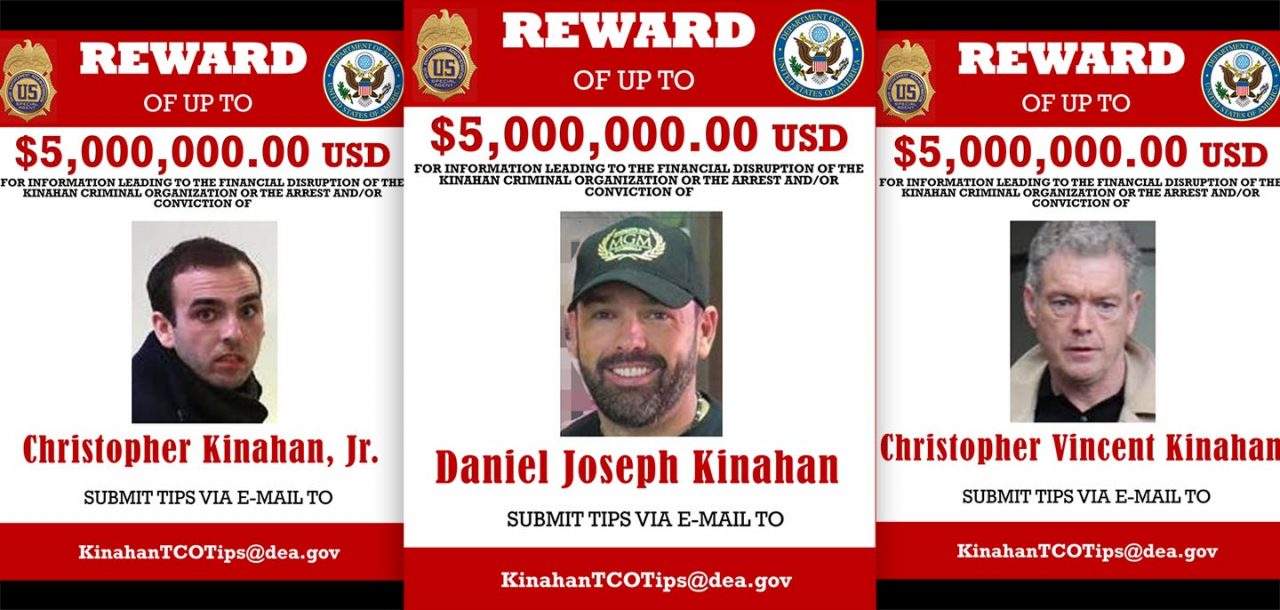
U.S. authorities issued wanted posters for members of the Kinahan family. Image: via U.S. State Department
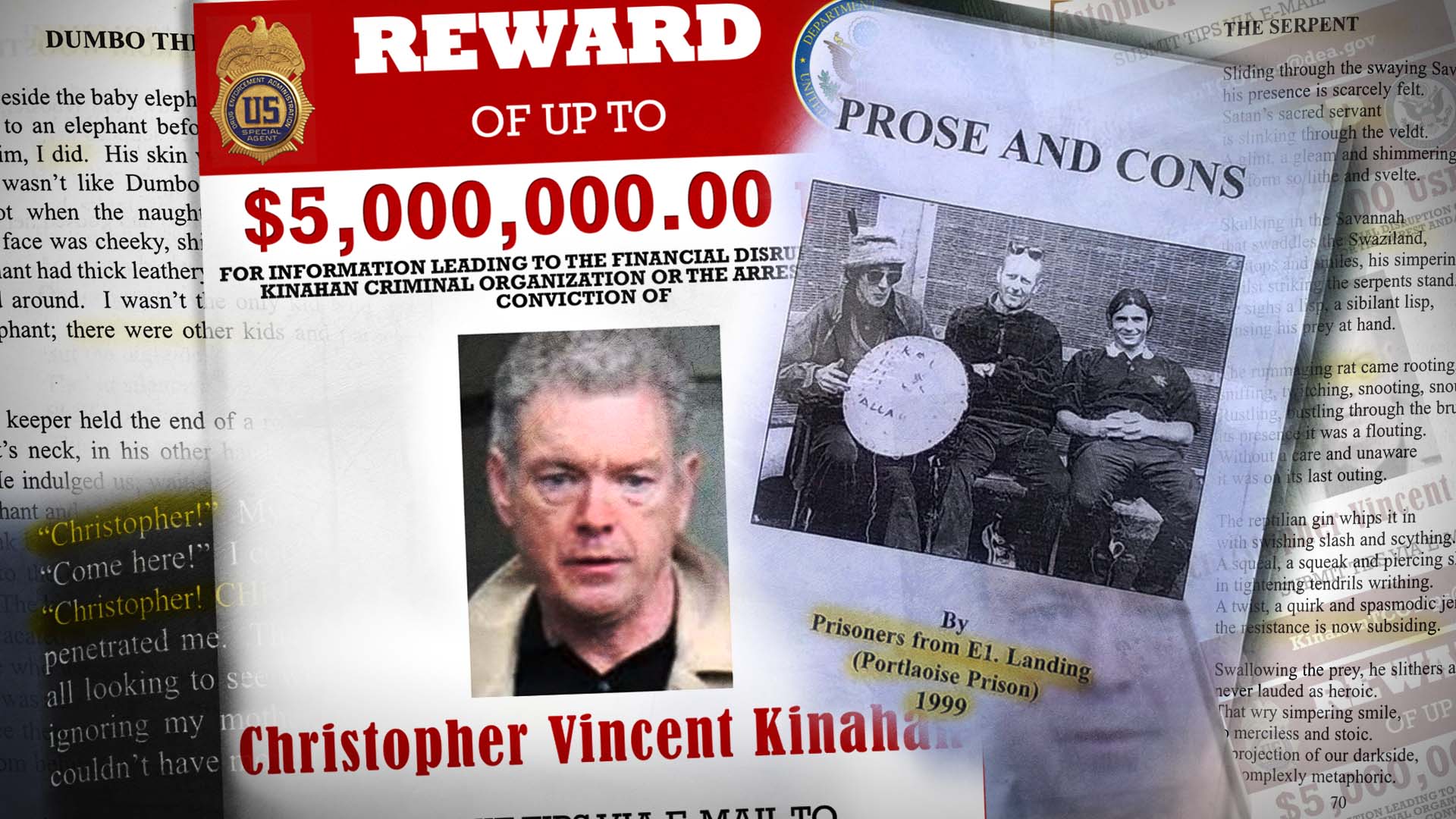
Kinahan Sr previously served time in Portlaoise Prison for trafficking heroin.
Two others alleged to be leaders of the Kinahan cartel, Ian Thomas Dixon and Bernard Patrick Clancy, also remain free in Dubai.
Large rewards have been offered for information leading to the men’s arrests and convictions.
Daniel Kinahan followed in the path of 40-year-old Sean McGovern, the first Kinahan cartel member to be extradited from Dubai to Dublin last year.
McGovern, a senior lieutenant in the group, was convicted of directing the activities of a criminal organization and is serving 24 years in prison.
Another key alleged Kinahan cartel figure, John Francis Morrissey, is currently on bail in Spain, where he is facing a money laundering investigation.
ope, engaging in money laundering, firearms trafficking and murder.Authorities say the Kinahan drug smuggling and money laundering empire stretched from the U.A.E to Ireland, the U.K., Colombia, Spain, the Netherlands, the U.S., Australia, Brazil and Zimbabwe.
A European Union investigation found the group used dozens of front companies to move heroin, cocaine and other drugs.
ICIJ uncovered Emirati corporate records showing that Kinahan and his younger brother established several Dubai companies.
https://www.icij.org/news/2025/05/christopher-kinahan-cian-sharkhin-portlaoise-prison-writing/
Recommended reading THE KINAHANS How a dark reimagining of ‘Dumbo the Elephant’ shaped the business dealings of an Irish drug lord May 16, 2025 KINAHAN CARTEL Drug kingpin Daniel Kinahan was paid millions ‘under the table’ to be boxing promoter’s exclusive agent, court complaint alleges Mar 05, 2025 CRIME CARTEL Dubai property portfolio calls into question effectiveness of sanctions on Kinahan cartel leader, experts say May 14, 2024
07.08.2026 à 06:01
The $200 billion company you can’t look inside
Spencer Woodman
Texte intégral (1442 mots)
Tether, which mints the world’s most widely used crypto token, is likely one of the most valuable private companies on earth, with an estimated value of $200 billion, exceeding the total share value of McDonald’s.
The company’s token, known as USDT, is a stablecoin pegged to the U.S. dollar that has become the backbone of a parallel banking system pervading parts of the world. The token has also become a key tool for money launderers for industrial-scale scam centers, which operate out of grim office complexes across Southeast Asia. Tether’s assistance in law enforcement investigations has become highly sought-after by agencies around the world struggling to address surging crypto crime.
Because of Tether’s barebones workforce — it employs just a few hundred people — the stablecoin giant’s low overhead helps to produce astonishing profits. These riches have made Tether a rainmaker in global finance, becoming a bigger buyer of U.S. government debt than Saudi Arabia or South Korea.
But who owns this powerful and controversial firm? The company has never given a full picture publicly. Estimates of who owns how much of Tether are at odds with each other. Because most firms worth many billions are publicly traded — a distinction that generally comes with disclosures of a firm’s major owners — Tether may also place among the most opaque companies of its size.
Questions around Tether’s ownership are of growing urgency, as U.S. Commerce Secretary Howard Lutnick’s firm Cantor Fitzgerald acquired rights to 5 percent of Tether in 2024, according to The Wall Street Journal. Such a stake could now be worth an estimated $10 billion. Like many of Tether’s ownership details, this remains unconfirmed by the company itself.
It’s a concern to have that much wealth and power built up within a small group of people with so little disclosure. — law professor Renée Jones
These unknowns epitomize a trend in which massive companies are increasingly opting to stay private instead of listing their stocks on public markets — a step that requires them to open up their books to the public. This means that regular people, investors and government officials are left with less information about companies even as they surge in size and importance. In Tether’s case, the private firm is pioneering a new global financial system while having never released results of a full audit of its reserves.
“It’s a concern to have that much wealth and power built up within a small group of people with so little disclosure,” says Renée Jones, a law professor at Boston College who has written extensively about problems posed by the opacity of large private companies. “It makes the jobs of regulators and government investigators harder when massive companies are not subject to a public disclosure regime in any country.”
In lieu of formal public disclosure of Tether’s major owners, the International Consortium of Investigative Journalists examined a mix of public records and internal company files to trace clues of who owns how much of the firm. In our reporting we found that, in its early days, Tether underwent large changes to its ownership that experts say appeared unusual and we found indications that one Tether executive, Giancarlo Devasini, may have recently increased his control over the firm.
Cryptocurrency’s original mission was in part to build a financial system free from government oversight. As it pushes the bounds of corporate privacy, Tether may hint at a future in which people can engage in anonymous financial transactions using private money minted by multinational behemoths that answer to few government authorities. That world might already be here today.
artup’s tokens a readily available distribution channel. Still, Tether struggled to get investment early on, with one founder later saying: “You can’t even imagine how stupid of an idea everyone thought it was.” Tether’s original founders ended up transferring their shares in the company to Bitfinex executives, according to “Number Go Up,” a 2023 book by Zeke Faux about crypto. These executives included Giancarlo Devasini and Jean-Louis van der Velde.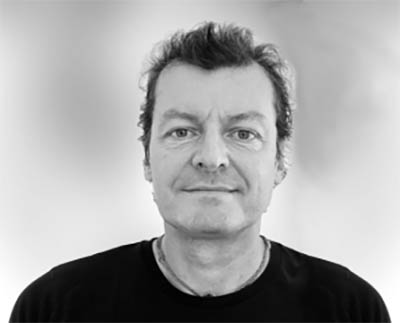
Giancarlo Devasini. Image: via Tether.to
In the years to come, they would turn Tether into a powerhouse. A former plastic surgeon, Devasini was hawking DVDs on a bitcoin forum just a decade before entering the ranks of the world’s wealthiest, according to Faux. Van der Velde, a Dutch entrepreneur, had previously dealt in electronics.
In Tether’s first few years, the two men moved company shares between themselves as if they were monopoly money. In early 2016, Devasini owned 100 percent of Tether Holdings, the British Virgin Islands firm identified as Tether’s parent company, according to shareholding records from ICIJ’s Paradise Papers trove that have not been previously reported.
In January of that year, Tether executives asked for a big change to the company’s ownership, and they wanted it quickly. In emails to their corporate administrator, Tether representatives arranged for documents to be sent to Hong Kong that would transfer at least 55% of Devasini’s shares in Tether Holdings to van der Velde, according to the records. In the transfer, another chunk of Devasini’s shares went to a firm called DigFinex Inc.
This arrangement didn’t last long. Tether ownership documents from around 2018 that ICIJ reviewed shows that, roughly two years later, van der Velde’s share of Tether had fallen to just around 15% while Devasini had risen to again become the firm’s largest single shareholder at roughly 43% ownership.
Several experts told ICIJ that such a dramatic transfer of ownership between partners is unusual, even in an early-stage startup, though not necessarily a red flag. The Tether records from around 2018 showed that Paolo Ardoino, now Tether’s CEO, owned about 3.5% of the firm at that time. Forbes estimates Ardoino now owns 20% of Tether.
The same ownership records listed a person named Kristian Hansen as owning 6.6% of Tether at the time. ICIJ was unable to reach Hansen. If retained, the stake would now be worth more than $13 billion, going by Forbes’ valuation of Tether.
The Wall Street Journal previously reported the 2018 ownership numbers for Devasini, van der Velde and two other businessmen who also held large stakes: Christopher Harborne and Stuart Hoegner. ICIJ was unable to determine their current ownership stakes. Tether did not respond to ICIJ’s questions about the ownership numbers.
Forbes ranks Devasini as the 22nd richest person on earth with an estimated net worth of $89.3 billion.

https://www.icij.org/investigations/coin-laundry/video-cryptocurrency-global-investigation/
VIDEO WATCH: How crypto companies have empowered a shadow economy Nov 17, 2025
Recommended reading VIDEO WATCH: How crypto companies have empowered a shadow economy Nov 17, 2025 CRYPTOCURRENCY Cryptocurrency giant Tether is wildly profitable. Can it do more to stop financial crime? Dec 01, 2025 CRYPTOCURRENCY Crypto giants moved billions linked to money launderers, drug traffickers and North Korean hackers Nov 17, 2025
05.08.2026 à 21:30
After cancer drug counterfeiting scandal, India imposes new tracing requirements
Nicole Sadek
Lire plus (492 mots)
Cancer drugs in India are getting new safety features to improve tracing and curb the spread of counterfeits.
Manufacturers of all cancer drugs sold in India have until July 2027 to add a QR code or barcode to their packaging that shows the medicine’s path from factory to patient, according to the Ministry of Health and Family Welfare. The new requirements apply not only to drugs manufactured in India but also to those imported into the country, such as Keytruda, a health official confirmed to The Indian Express this week.
As part of the Cancer Calculus investigation, The Indian Expressand the International Consortium of Investigative Journalistsexamined India’s counterfeit Keytruda market, where counterfeiters took advantage of cancer patients and sold them falsified versions of the medication.
Reporting focused on a case in 2024 when police in New Delhi arrested 12 men for allegedly stealing empty Keytruda vials from hospitals and pharmacies and refilling them with antifungal medicine. The men then allegedly sold the spurious medicines at a fraction of the cost of authentic Keytruda. In India, the drug is unaffordable for most families; the market price for a 100-mg vial of Keytruda is 150,000 rupees, or more than $1,500. The case affected patients beyond India, too. At least one Nepalese woman purchased medicine from one of the accused defendants, ICIJ reported.
https://www.icij.org/investigations/cancer-calculus/cancer-drug-counterfeits-keytruda-immunotherapy/
COUNTERFEITS Counterfeiters cash in on the world’s bestselling cancer drug Apr 13, 2026
https://www.icij.org/investigations/cancer-calculus/merck-keytruda-cancer-drug-price/
Recommended reading COUNTERFEITS Counterfeiters cash in on the world’s bestselling cancer drug Apr 13, 2026 OVERVIEW How Merck turned its wonder drug into a blockbuster — and priced out cancer patients worldwide Apr 13, 2026 INSURERS ‘They deny the medication that is keeping you alive’: Patients wage grueling legal battles for lifesaving cancer drug Apr 13, 2026
- GÉNÉRALISTES
- Le Canard Enchaîné
- La Croix
- Le Figaro
- France 24
- France-Culture
- FTVI
- HuffPost
- L'Humanité
- LCP / Senat
- Le Media
- La Tribune
- Time France
- EUROPE ‧ RUSSIE
- Courrier Europe Ctrale
- Desk-Russie
- Euractiv
- Euronews
- Toute l'Europe
- Afrique ‧ Asie ‧ Proche-Orient
- Haaretz
- Info Asie
- Inkyfada
- Jeune Afrique
- Kurdistan au féminin
- L'Orient - Le Jour
- Orient XXI
- Rojava I.C
- INTERNATIONAL
- Courrier International
- Equaltimes
- Global Voices
- Infomigrants
- I.R.I.S
- The New-York Times
- OSINT ‧ INVESTIGATION
- OFF Investigation
- OpenFacto°
- Bellingcat
- Disclose
- G.I.J
- I.C.I.J
- OPINION
- Au Poste
- Cause Commune
- CrimethInc.
- Hors-Serie
- L'Insoumission
- Là-bas si j'y suis
- Les Jours
- LVSL
- Politis
- Quartier Général
- Rapports de force
- Reflets
- Reseau Bastille
- StreetPress
- OBSERVATOIRES
- Armements
- Acrimed
- Conspirationnisme
- Culture
- Curation IA
- Extrême-droite
- Human Rights Watch
- Inégalités
- Justice fiscale
- Liberté de création
- Multinationales
- Situationnisme
- Sondages
- Street-Médics
- Routes de la Soie
- Wokisme